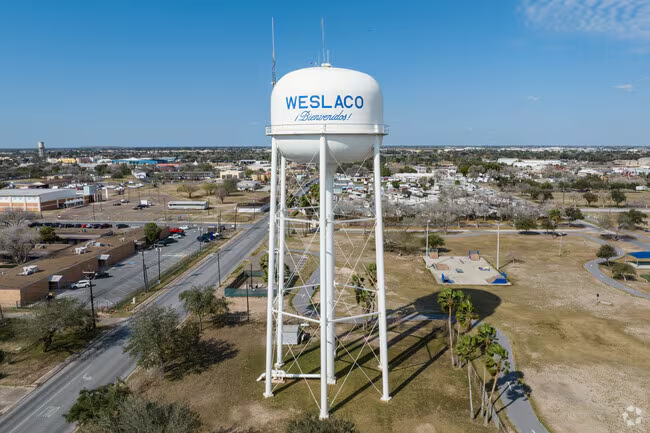
Weslaco had a genuine public emergency. Its water and wastewater infrastructure had exceeded its expected operating life, and the FBI affidavit that opened the federal corruption case said the Texas Commission on Environmental Quality had notified the city in 2004 that its treatment facilities violated state environmental regulations.
Residents needed dependable drinking water. City leaders needed to repair facilities that had deteriorated over decades. The men controlling the contracting process saw tens of millions of dollars that could be routed through engineering companies, consultants, political intermediaries and elected officials.
From approximately 2008 through 2016, former Weslaco commissioners John F. Cuellar and Gerardo Tafolla accepted bribes in exchange for official action favorable to companies seeking the city’s water infrastructure business. Former Hidalgo County Commissioner Arturo C. Cuellar Jr., businessman Ricardo Quintanilla and consultant Leonel “Leo” Lopez helped move the money. The Justice Department’s account of the convictions established that more than $400,000 was disguised as payment for legal work that was never performed, while other bribes were delivered to Tafolla in envelopes containing cash.
The money surrounding the scheme was immense. The United States Court of Appeals for the Fifth Circuit found that Weslaco paid approximately $42.5 million to Camp Dresser & McKee, Briones Consulting and Engineering and LeFevre from March 2008 through December 2016. Lopez received millions from companies involved in the projects, paid approximately $1.4 million to Arturo Cuellar and paid Quintanilla $93,930.
The criminal case eventually produced guilty pleas, jury convictions, prison sentences, fines, forfeiture judgments and a $4.1 million restitution order. The Justice Department’s sentencing records show that Arturo Cuellar received 20 years in federal prison, Quintanilla received 200 months and John Cuellar received three years. Tafolla later received 30 months for accepting bribes tied to the contracts.
The convictions survived appeal. In August 2024, the Fifth Circuit affirmed the convictions and sentences, rejecting the challenges brought by Arturo Cuellar and Quintanilla.
The legal record leaves no serious dispute about the central betrayal. Elected officials responsible for protecting Weslaco’s residents sold their governmental power while the public assumed debt for an essential service.
A Public Emergency Became a Private Opportunity
Weslaco’s infrastructure problem had been developing for decades. The Fifth Circuit’s summary of the trial record said the city’s water infrastructure had an estimated lifespan of 50 years that had already expired by the 1980s. The city had been struggling with its water and wastewater plants since at least 1995, and major repair projects began around 2007 or 2008.
The regulatory pressure was also real. The FBI’s sworn probable cause affidavit said the Texas Commission on Environmental Quality notified Weslaco in approximately 2004 that the city’s water treatment plant and its north and south wastewater facilities violated environmental regulations.
In approximately 2007, the Weslaco City Commission approved about $28 million in municipal bonds to finance infrastructure projects. The two largest projects were the rebuilding of the north wastewater treatment plant and repairs to the drinking water treatment plant, according to the federal affidavit assembled from city records, interviews and financial documents.
The contracting arrangement concentrated extraordinary influence in the hands of the construction manager. The affidavit said the company selected to manage the bond projects could effectively choose the businesses that would perform the infrastructure work. It then selected itself, subject to commission approval, for the two most expensive projects funded by the bonds.
The projects themselves were necessary. That necessity became part of the protection surrounding the scheme. Contractors could perform legitimate engineering work while consultants and political intermediaries moved bribe money behind the public process. Residents saw meetings, contracts, construction plans and bond payments. They could not see the private financial agreements influencing the votes.
The Fifth Circuit later rejected the idea that the genuine need for repairs excused the conduct. The court explained that the necessity of the projects had no bearing on whether the defendants committed bribery. An official can support a needed project and still commit a crime by accepting money for the vote.
The Commission Majority Had a Power Broker
John Cuellar served on the Weslaco City Commission from May 1995 until losing reelection in November 2014. He was repeatedly selected as mayor pro tem and remained a central figure in city government for nearly two decades.
The FBI affidavit described John Cuellar as the effective leader of the commission’s majority voting bloc during most of the conspiracy. Investigators attributed his influence to his long tenure and his relationship with Arturo Cuellar, who had served as a Hidalgo County commissioner and remained a prominent political figure.
That influence mattered because the commission controlled the contracts. A company did not need to corrupt every voter or every city employee. It needed a majority capable of approving agreements, protecting existing contractors and directing additional work.
The federal superseding indictment recorded a series of official actions involving John Cuellar. On March 25, 2008, he moved to grant a professional services contract for engineering work connected to the water and wastewater projects and voted for his own motion. In May 2008, while acting in the mayor’s absence, he executed the professional services agreement.
In November 2008, Cuellar moved to place additional projects under the same company’s contract and voted for the motion. When commissioners later considered shifting bond funds away from the proposed north wastewater plant, he opposed the change because it would have reduced the amount of money available under the existing contracts.
The indictment also said Cuellar moved to suspend commission procedures so a defeated funding proposal could be reconsidered. He then sought to restore equal priority to the water and wastewater projects, preserving the amount of money available under the favored contracts.
Those actions occurred in public meetings. The corruption influencing them remained hidden behind private payments and political relationships.
A Second Commissioner Agreed to Take Cash
Gerardo Tafolla joined the Weslaco City Commission in 2009 after an earlier unsuccessful campaign. Ricardo Quintanilla had managed both of his campaigns, creating a political relationship that later became a channel for bribery.
After Tafolla took office, Quintanilla introduced him to Lopez and engineer Rolando Briones. The Fifth Circuit’s account of the trial evidence described a series of meetings among Tafolla, Quintanilla, Lopez and Arturo Cuellar as the men attempted to repair political relationships and secure support for the water project.
The appellate court carefully distinguished among those meetings. One gathering at Cimarron Country Club concerned Tafolla “mending fences” with Arturo Cuellar and did not involve a discussion of votes. A later meeting among Tafolla, Quintanilla and Lopez did concern the plant and the effort to acquire commission support.
Lopez and Quintanilla discussed the need for votes loudly enough for Tafolla to understand what they wanted. Afterward, Quintanilla told Tafolla that he would divide whatever money he received from Lopez if Tafolla voted for the plan.
Tafolla agreed to accept the bribes.
The trial record summarized by the Fifth Circuit showed that Tafolla received repeated $1,000 payments in envelopes. He watched Lopez give the envelopes to Quintanilla, who divided the cash between Tafolla and himself.
Quintanilla paid Tafolla between approximately $10,000 and $15,000. Tafolla continued meeting with Lopez and Quintanilla every few months, and he later voted for Briones and Camp Dresser & McKee to receive their respective contracts.
The direct payment to Tafolla was small compared with the public money controlled by his vote. Several thousand dollars in envelopes helped influence decisions tied to contracts worth tens of millions.
That imbalance explains why local bribery can be so profitable. The conspirators did not have to pay officials an amount resembling the value of the contract. They needed to provide enough private benefit to purchase the required votes.
The Cuellar Cousins Invented Legal Work That Never Happened
The largest direct stream of bribe money to a sitting Weslaco commissioner traveled through Quality Ready Mix, a company controlled by Arturo Cuellar.
Arturo and John Cuellar were first cousins. John held a vote on the Weslaco City Commission. Arturo had political influence, business interests and access to money flowing from Lopez.
Beginning in approximately April 2011, Arturo Cuellar directed employees of Quality Ready Mix to send John Cuellar payments ranging from approximately $5,000 to $7,500 twice each month. The superseding indictment traced the transfers through November 2014.
The payments were entered as compensation for legal services. John Cuellar performed no legal work for Quality Ready Mix.
The arrangement moved approximately $405,000 to the commissioner. The Fifth Circuit found that Lopez, Arturo Cuellar and John Cuellar invented the legal services explanation to disguise the bribes.
John understood what Arturo expected in return. The appellate court said John knew Arturo wanted him to support Briones as the engineer for the plant design and Camp Dresser & McKee as the construction company.
The payments stopped promptly in November 2014, when John Cuellar lost his reelection campaign. The indictment specifically identified the timing, while the appellate court noted that he stopped receiving the money once he lost his seat.
The end of the payment stream exposed the arrangement’s true nature. A legitimate legal engagement would not ordinarily become worthless the moment a lawyer lost a city commission election. The supposed work ended when John could no longer supply official action.
The scheme used ordinary business records to conceal extraordinary corruption. The checks did not identify themselves as bribes. They carried the false appearance of professional compensation, allowing stolen public trust to be recorded as a routine company expense.
Millions Passed Through the Consultant
Leonel Lopez stood near the center of the financial network.
The Justice Department’s announcement of the superseding indictment said Lopez pleaded guilty to federal program bribery in March 2019. Federal records described him as a consultant who received approximately $4.1 million from two engineering companies and shared about $1.398 million with Arturo Cuellar.
The Fifth Circuit’s later review of the trial evidence placed Lopez in the money chain connecting the engineering work to the public officials. Lopez paid Arturo Cuellar about $1.4 million and paid Quintanilla $93,930. Arturo then directed money to John Cuellar, while Quintanilla divided cash with Tafolla.
The arrangement separated the companies benefiting from public contracts from the officials casting the votes. Engineering companies paid a consultant. The consultant paid political intermediaries. The intermediaries retained portions of the money and transferred the rest to commissioners.
Each layer created distance and plausible deniability. A payment from a contractor directly to a commissioner would have been difficult to explain. Consultant payments, business checks and political relationships created a more complicated trail.
The trail was complicated, but it was not invisible. The FBI and Internal Revenue Service Criminal Investigation reconstructed it through bank records, commission documents, communications and witness testimony. The Justice Department credited both agencies with unraveling the financial structure and bringing the participants to court.
The Paper Trail Included a Backdated Agreement
The conspirators understood that payments required documentation capable of surviving scrutiny.
From July 2012 through February 2016, Briones, LeFevre, Quintanilla and Lopez exchanged written communications concerning the water treatment plant. The Fifth Circuit highlighted a November 2012 email discussing the need to execute a backdated consulting agreement.
The appellate court said the apparent purpose was to protect the participants from legal liability.
A backdated agreement could make earlier payments appear to have been authorized by a legitimate contract that existed when the money changed hands. It provided a paper explanation after the fact.
The scheme therefore operated through two records. The public record contained agendas, engineering reports, motions, invoices and commission votes. The private record contained envelopes, consulting payments, false legal fees and an agreement created with an earlier date.
The public process gave the contracts legitimacy. The concealed financial process determined who benefited from them.
The City Paid $42.5 Million Through the Corrupted Process
The original municipal bond issue was approximately $28 million and covered several infrastructure projects. Payments connected to the companies and individuals involved in the water treatment work eventually exceeded that initial figure.
The Fifth Circuit calculated that Weslaco paid approximately $34 million to Camp Dresser & McKee, $8.5 million to Briones and $150,000 to LeFevre between March 2008 and December 2016. The combined total was approximately $42.5 million.
A final project cost exceeding an original bond issue does not automatically establish wrongdoing. Construction scopes change, cities authorize additional work and projects encounter higher costs. The decisive fact in Weslaco is that the payments occurred through a contracting environment corrupted by proven bribery.
The Justice Department described the contracts influenced by the scheme as worth approximately $38.5 million. The Fifth Circuit’s larger $42.5 million figure included the wider set of payments to CDM, Briones and LeFevre reflected in the trial record.
The difference between those figures does not weaken the case. Both demonstrate the scale of the government business touched by the conspiracy. A few thousand dollars in cash and several hundred thousand dollars in fabricated legal payments helped manipulate decisions controlling tens of millions in public expenditures.
The Corruption Survived Multiple Election Cycles
The scheme lasted from approximately March 2008 through December 2016. It survived changes in projects, commission meetings, payment methods and political offices.
John Cuellar’s long tenure gave the arrangement stability. Tafolla supplied another commission vote. Arturo Cuellar moved money through a company he controlled. Quintanilla used his relationship with Tafolla to deliver cash. Lopez connected the payments to the engineering business surrounding the projects.
The superseding indictment described the purpose of the conspiracy in direct terms. John Cuellar and Tafolla were to enrich themselves by accepting bribes and using their public positions. Arturo Cuellar and Quintanilla were to keep portions of the money they received before passing the remainder to the commissioners. Lopez was to retain part of the money paid through the engineering companies.
The division of labor protected the structure. No single participant performed every part of the operation. Companies obtained work. A consultant collected money. Political intermediaries moved it. Commissioners supplied official action.
Residents looking at the individual pieces could see separate contractors, consultants, businesses and politicians. Federal investigators assembled the pieces into one bribery machine.
Quintanilla Tried to Manufacture Another Explanation
The effort to protect the scheme continued after the investigation reached federal court.
During the criminal case, Quintanilla visited the office of Weslaco City Attorney John Gonzalez. The Fifth Circuit’s account of the trial evidence said Quintanilla asked Gonzalez to testify that the city had hired him as a consultant.
Gonzalez refused.
Quintanilla left the office, returned minutes later and warned him, “you better not f*** this up for me.” Gonzalez believed he was being asked to commit perjury.
The episode followed the same logic used to conceal the earlier payments. When the money trail became dangerous, the participants needed official looking explanations. Bribes became legal fees. Existing payments required a backdated consulting contract. A criminal defense needed the city attorney to validate employment that he said did not exist.
Gonzalez refused to provide that protection. His refusal prevented another false account from entering the city’s official record.
The Jury Convicted the Political Power Brokers
Arturo Cuellar and Quintanilla took their cases to trial in October 2022. John Cuellar, Tafolla and Lopez had already pleaded guilty to offenses connected to the conspiracy.
The Justice Department announced the trial verdicts on Oct. 21, 2022. The jury found that Arturo Cuellar and Quintanilla had participated in the scheme to bribe Weslaco commissioners in exchange for actions favorable to companies seeking the city contracts.
The Fifth Circuit’s detailed accounting of the verdict shows that Arturo Cuellar was convicted of 61 counts. Those included conspiracy to commit honest services wire fraud, four counts of honest services wire fraud, federal program bribery, conspiracy to commit money laundering, 27 money laundering counts and 27 Travel Act violations.
Quintanilla was convicted of 15 counts, including conspiracy to commit honest services wire fraud, four honest services wire fraud counts, federal program bribery, conspiracy to commit money laundering and eight money laundering counts.
These were no longer untested accusations in an indictment. A federal jury heard the evidence and returned guilty verdicts.
The Sentences Reflected the Scale of the Scheme
In January 2023, Arturo Cuellar received 20 years in federal prison. The court also imposed a $915,000 fine, a $6,100 special assessment, forfeiture of $947,454 and joint responsibility for $4.1 million in restitution.
The Fifth Circuit recorded the complete financial judgment and noted that Arturo Cuellar received a less generous downward variance than Quintanilla because Cuellar had profited more substantially from the conspiracy.
Quintanilla received 200 months in prison, equivalent to 16 years and eight months. He was also ordered to pay a $15,000 fine, a $1,500 assessment and $4.1 million in restitution jointly with Arturo and John Cuellar. The court ordered forfeiture of $75,080.
John Cuellar received three years in prison after pleading guilty to conspiracy to commit honest services fraud. The Justice Department’s sentencing announcement emphasized that the defendants had exploited a city already under pressure to repair its drinking water infrastructure.
Gerardo Tafolla received 30 months in prison in November 2023. The Justice Department said at his sentencing that he and John Cuellar accepted bribes for official action benefiting engineering companies seeking contracts worth tens of millions of dollars.
The sentences punished the elected officials and intermediaries at different levels of the operation. They also exposed the enormous difference between the bribes received by individual commissioners and the value of the public business their votes helped control.
The Convictions Survived Federal Appeal
Arturo Cuellar and Quintanilla appealed their convictions, sentences, evidentiary rulings, forfeiture judgments and restitution obligations.
The Fifth Circuit rejected their arguments in August 2024. The court found that the evidence supported a coordinated conspiracy whose purpose was to enrich the participants by directing Weslaco’s contracts toward the favored companies.
The appellate court affirmed the convictions and sentences. It also rejected efforts to argue that the water projects were necessary and that the city would have selected the companies without the bribes.
The court explained that necessity was not a defense. A public official commits bribery by accepting payment for official action even when the action might otherwise have been defensible on policy grounds.
That holding reaches the heart of the Weslaco scandal. The defendants attempted to hide behind the reality that the city needed water infrastructure. The need for the project made their betrayal more severe because they attached private corruption to a service residents could not live without.
Residents Paid for Infrastructure and the Corruption Around It
Weslaco residents financed the projects through municipal debt and the long term obligations of the city’s utility system.
They also absorbed the financial burden created by a contracting process corrupted by bribes.
The Justice Department said when the defendants were sentenced that Weslaco had been warned for years to improve its water system and that the defendants exploited the crisis through a multimillion dollar scheme that saddled residents with debt and bribery costs.
Bribe money does not appear as a separate charge on a water bill. It becomes buried within consulting arrangements, engineering fees, subcontracts and the cost companies assign to obtaining public business.
The public cannot easily separate the cost of necessary work from the cost of corruption once both have entered the same contract. That uncertainty is one of the lasting injuries caused by municipal bribery.
The federal court imposed $4.1 million in restitution, along with fines and forfeiture judgments. The federal records cited in this article establish the amounts ordered but do not provide a complete public accounting of how much Weslaco has actually recovered.
A restitution judgment does not guarantee that the full amount will be collected. Weslaco residents deserve a current accounting showing money received through restitution, forfeiture, insurance, civil claims or settlements and the amount that remains unpaid.
The City Still Owes Residents an Institutional Accounting
The criminal prosecutions answered who participated in the bribery conspiracy and what punishment the federal court imposed.
They did not provide a complete public explanation of what Weslaco changed inside its own government.
Residents should be able to examine every contract, amendment, consultant disclosure, payment authorization and subcontract connected to the corrupted projects. The city should identify whether it pursued civil recovery, professional liability claims or contractual remedies against any person or company that benefited from the tainted process.
Weslaco should also publish the procurement controls adopted after the convictions. Those records should show how the city now reviews professional service contracts, verifies consultant relationships, detects payments to political intermediaries, documents conflicts of interest and restricts private communications between commissioners and vendors.
The public needs more than assurances that current officials would behave differently. The entire scheme succeeded because official paperwork made corrupt decisions appear routine.
Real reform must be visible in the rules, disclosures and records controlling public money.
A Water Plant Became a Political ATM
The Weslaco conspirators did not invent a fictional project. The city truly needed water infrastructure. Engineers and contractors performed work connected to actual facilities. Commissioners held public meetings and cast recorded votes.
The corruption operated inside those legitimate functions.
A public emergency created the funding. Contractors sought the work. Consultants moved the money. Political intermediaries separated the companies from the officials. Commissioners converted their votes into personal income.
John Cuellar received approximately $405,000 through payments disguised as legal fees for services he never performed. Tafolla accepted envelopes containing $1,000 cash payments. Arturo Cuellar received about $1.4 million from Lopez and used his company to move bribe money to his cousin. Quintanilla received $93,930 and divided part of the money with Tafolla. The city paid approximately $42.5 million through the contracting network described at trial.
The public meetings concealed private transactions. The invoices concealed political payments. The legal descriptions concealed bribery.
That was the wickedness of the Weslaco scheme. The conspirators attached their personal enrichment to clean water, one of the most basic obligations a city owes its people. They knew residents had no practical alternative and that the infrastructure work could not simply be abandoned.
Federal investigators dismantled the arrangement. A jury convicted its central power brokers. The Fifth Circuit upheld the result.
Weslaco’s remaining duty is disclosure. The city should publish the financial aftermath, identify every corrective measure and tell residents how much of the court ordered money has been recovered.
The people of Weslaco already paid for the water system. They should not have to keep paying for secrecy surrounding the officials who turned it into a source of bribes.