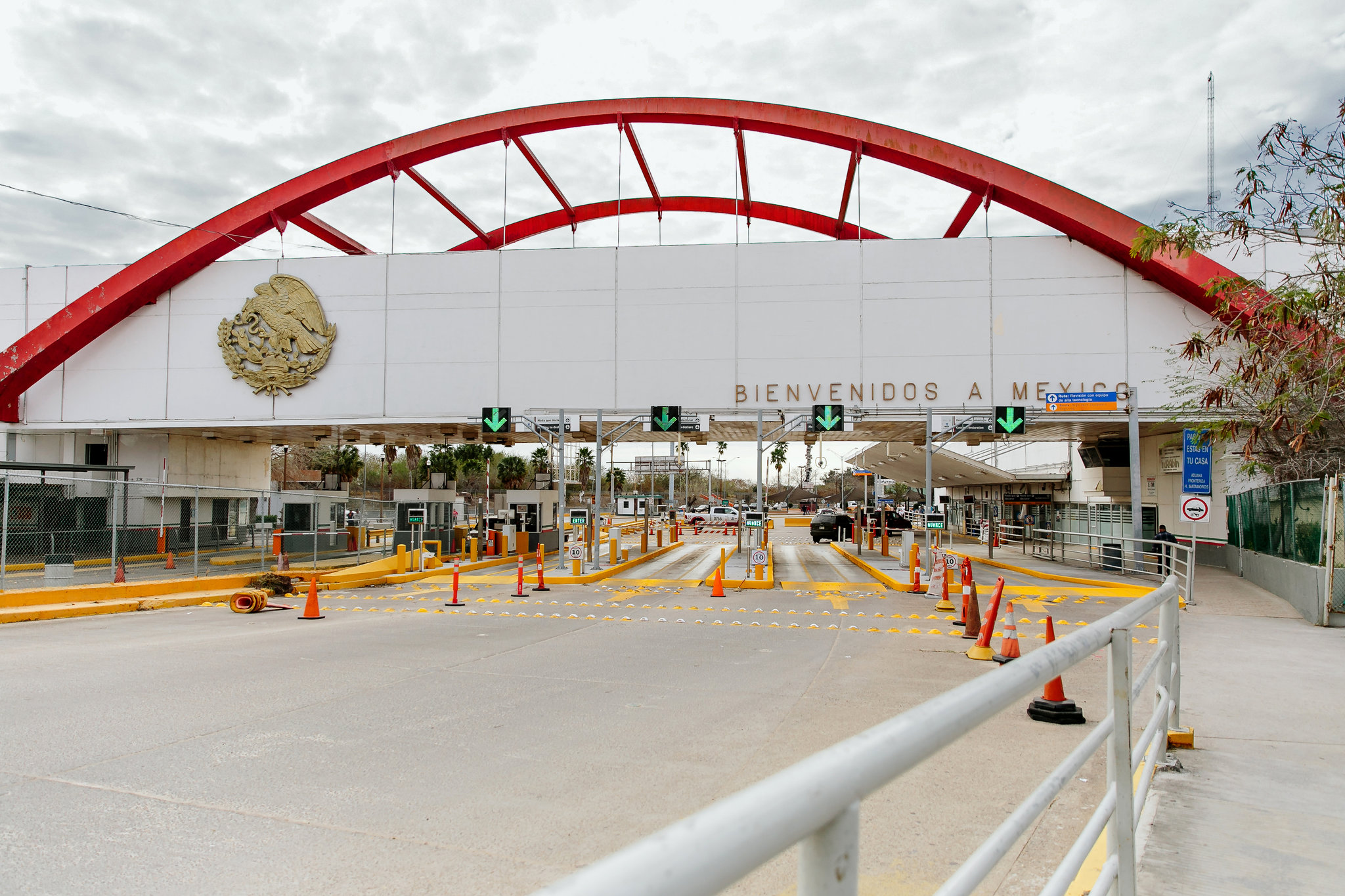
On March 7, 2019, a woman identified in federal court records only as C.R. was organizing drivers into a caravan just across the border in Mexico when gunmen opened fire. C.R. survived. Her client, Rocio Alderete, died where she was shot.
The attack followed months of pressure against C.R., who operated in the transmigrante trade near the Free Trade International Bridge at Los Indios. Federal prosecutors said she had refused to surrender money to a price-fixing organization called “The Pool.” Members had discussed having her beaten, threatened her relatives and ordered her to stop doing business at the bridge. One of her associates had already been assaulted in Mexico. The daughter of another employee had been kidnapped with her boyfriend.
On the same date Alderete was killed, owners and employees of transmigrante forwarding agencies gathered at a Holiday Inn in Harlingen. The purpose of the meeting, as described in a 28-page federal indictment, was to agree on prices and redistribute revenue controlled by The Pool. Approximately $44,000 in cash was brought to the meeting.
The meeting exposed the two faces of the enterprise operating in northern Cameron County. In Harlingen conference rooms and restaurants, members discussed prices, percentages, fines and collections. Across the river, competitors and their employees faced beatings, kidnappings and gunfire.
The operation was not a brief eruption of border violence. Federal prosecutors traced the price-fixing conspiracy from approximately 2011 through November 2022. For more than a decade, a private criminal organization gained control over an industry built around a bridge owned and operated by Cameron County, eight miles south of Harlingen and San Benito.
By the time the federal case was substantially resolved, the conspiracy’s leader had admitted responsibility for collecting at least $9.5 million in extortion payments. Eight other defendants had been convicted, three accused participants remained fugitives and multiple victims were dead.
The federal prosecutions punished many of the people directly involved. They left another question largely unanswered: How did an extortion regime rooted in local businesses, local meetings and a publicly owned center of international commerce remain powerful for so long?
A Public Bridge Created a Private Choke Point
Transmigrantes transport used vehicles and other merchandise from the United States through Mexico for resale in Central America. The vehicles frequently originate in states far from Texas before arriving in Cameron County, where drivers obtain paperwork, permits and customs assistance for the journey south.
Until approximately March 2021, Mexican regulations required transmigrantes entering from the United States to use the Los Indios crossing. That rule concentrated an entire international trade in one small section of Cameron County.
Transmigrante forwarding agencies served as intermediaries. They helped drivers complete documents, pay required fees and arrange access to Mexican customs brokers known as patentes. These brokers were licensed and bonded in Mexico to process the paperwork needed for vehicles to travel through the country.
Control over a patente relationship could therefore determine who was allowed to compete. Several agencies associated with the conspiracy maintained exclusive relationships with particular brokers. Businesses lacking those connections had to obtain broker services through agencies already inside the system, giving established operators enormous power over new competitors.
The public infrastructure underneath this market belonged to local government. The Cameron County International Bridge System identifies the Free Trade Bridge as a county-owned and county-operated crossing situated on a 127-acre complex. Harlingen and San Benito each receive 25 percent of its net revenues through interlocal agreements. The federal inspection facility is operated by the Department of Homeland Security.
The federal case does not accuse Cameron County, Harlingen, San Benito, bridge employees or federal customs officers of joining the conspiracy. The extortionists operated through private forwarding agencies and cross-border criminal relationships.
The bridge’s public ownership nevertheless matters. This was not an obscure underground market hidden in a distant corner of Mexico. The conspiracy organized commerce flowing through one of Cameron County’s most important public assets. Its members conducted business in the Los Indios area, gathered in Harlingen, monitored agencies working near the crossing and, according to the Justice Department, could prevent clients from reaching the bridge.
The Pool Replaced Competition With Submission
The organization’s name was disarmingly ordinary.
“The Pool” referred to a centralized arrangement through which participating agencies combined revenue and divided the money according to predetermined percentages. Its members established common prices, monitored whether agencies obeyed them and punished businesses that attempted to charge less or operate independently.
The system converted nominal competitors into members of a controlled cartel. Customers could no longer depend on agencies competing honestly for their business. An agency that reduced its prices threatened every conspirator’s share of the pool.
The Justice Department’s account of the guilty pleas said the conspirators forced forwarding agencies to surrender money to The Pool, limited outside competition and increased prices for their services. Businesses operating outside the organization could be compelled to join, pay fines or abandon the market.
The Pool also collected a separate extortion payment called a piso, or floor tax, on every transaction. The federal indictment said the charge began at approximately $40 per vehicle around 2013, increased to $65 in 2017 or 2018 and reached $80 by 2019.
This was not a legitimate bridge toll or customs fee. It was private tribute demanded for the ability to conduct lawful business and move safely through the industry.
The federal indictment estimated that roughly 675,000 transmigrante exports occurred between January 2014 and April 2022, producing at least approximately $27 million in extortion payments. That figure appeared as an allegation in the indictment rather than the amount ultimately attributed to every convicted defendant. The later sentencing record established that Carlos Favian Martinez, the conspiracy’s leader, was personally responsible for collecting at least $9.5 million.
The scale reveals how systematic the operation had become. A few isolated shakedowns could be concealed. Hundreds of thousands of transactions required spreadsheets, collection systems, enforcement mechanisms and a network capable of tracking who worked, what they charged and whether they had paid.
Prosecutors said Pool members created charts and spreadsheets, announced prices, monitored agencies and punished participants who violated the arrangement. The conspiracy possessed the administrative structure of a trade association and the enforcement methods of organized crime.
The Leader Brought a Cartel Shadow to the American Side
Martinez, known as “Cuate,” operated a forwarding agency in the Los Indios area. The federal indictment identified him as the son-in-law of a former leader of the Gulf Cartel, the violent criminal organization long associated with Tamaulipas and the northeastern Mexican border.
Marriage to a cartel figure does not by itself establish criminal responsibility. Martinez’s own guilty pleas and sentence established his role in this enterprise. He admitted participating in price fixing, monopolization, extortion and money laundering.
The Justice Department’s June 2025 sentencing announcement described him as the leader of a “long-running and violent conspiracy” that controlled the forwarding industry through monopolization and extortion. He was sentenced to 11 years in federal prison and ordered to pay a $2 million fine.
The U.S. Attorney’s Office offered an even starker description of the system. Businesses or clients that resisted could be denied access to the Los Indios bridge or have their vehicles stolen. In more serious cases, victims were kidnapped, beaten, firebombed, shot or killed.
That range of punishments explains why ordinary competition disappeared. A small forwarding agency was not deciding whether to participate in an aggressive commercial association. Its owner was deciding whether lower prices were worth risking an attack on employees or family members.
A Competitor Refused to Pay. The Threats Escalated
The indictment’s account of the campaign against C.R. shows how commercial disagreements became death threats.
During July and August 2018, prosecutors alleged, Martinez and Marco Antonio Medina exchanged WhatsApp messages complaining that C.R. charged prices below those established by The Pool and refused to surrender revenue. They discussed having her beaten.
Another Pool member sent a message stating that people in Matamoros were waiting for Martinez to authorize her punishment. Other conspirators pressed Medina to act and reported their attempts to force her into compliance.
On Sept. 20, 2018, C.R. received messages ordering her to withdraw from the bridge and leave the transmigrante business. The senders claimed to be associated with the Matamoros plaza and told her that they had already located members of her family.
One week later, an employee and business associate was assaulted while escorting transmigrante clients in Mexico. The attackers said they worked for Cuate and told the victim that the beating demonstrated what happened to people who refused to cooperate.
In February 2019, the daughter of one of C.R.’s employees and the daughter’s boyfriend were kidnapped in Mexico. The victims heard their captors say that the abduction resulted from the father’s work for C.R.
Then came the March 7 shooting. C.R. survived and abandoned the industry. Alderete did not survive.
The indictment did not charge the defendants with Alderete’s murder, and a criminal indictment contains allegations that must be distinguished from convictions. The later guilty pleas established the price-fixing, monopolization and extortion conspiracies, but they did not amount to separate murder convictions for every violent act described by prosecutors.
That legal distinction is necessary. It does not diminish the horror documented in the federal case: competitors were threatened, their relatives were located, associates were assaulted and a woman was killed after the organization spent months discussing how to punish resistance.
Three Workers Were Shot After Another Owner Defied the Pool
C.R.’s departure did not end the violence.
In October 2019, another agency owner, identified as L.G., refused to join The Pool or pay its piso. She began obtaining customs services through a broker unaffiliated with the defendant agencies.
The response was swift. On Oct. 24, vehicles belonging to one of the agency’s clients were burned.
On Nov. 5, three of L.G.’s employees were shot in Mexico near the Los Indios port of entry. Abelardo Flores Mora died at the scene. Rodrigo Martin del Campo died after being taken to a hospital in the United States. Oscar Guerrero, who was also L.G.’s nephew, died from his injuries months later.
One week after the shooting, another client was kidnapped and robbed in Mexico. Later that month, gunmen fired at L.G.’s brother while he drove near the Mexican side of the crossing.
The customs broker working with L.G. received threatening telephone calls. The callers said he was not authorized to work in the industry, knew where his offices were located and knew the identities of his relatives.
The sequence documented in the federal indictment displayed the enterprise’s method with brutal clarity. First came a demand for conformity. Then property destruction. Then shootings, kidnapping and threats against relatives. Violence did not merely accompany the price-fixing system. It protected the monopoly by making an example of anyone who attempted to escape it.
A $50,000 “Fine” Was Delivered at a Harlingen Wendy’s
The extortion operation moved easily between cross-border violence and ordinary American commercial spaces.
On Dec. 12, 2019, L.G. met Diego Ceballos-Soto at a Wendy’s restaurant in Harlingen. The indictment alleged that Ceballos-Soto said he had met with Martinez and communicated the organization’s decision: L.G. owed a $50,000 fine for working with an unauthorized broker, along with additional money for unpaid piso fees.
Four days later, L.G. paid approximately $47,000. On Dec. 20, she paid another approximately $42,000.
Ceballos-Soto later sent an image showing how the fine and unpaid fees had been calculated. The image was preserved in Martinez’s iCloud account, prosecutors said.
On Dec. 23, Carlos Yzaguirre met with agency owners who had conducted business through L.G.’s broker. Attendees were not allowed to carry telephones, and steps were taken to detect recording equipment. Yzaguirre warned them that they had to stop using the unauthorized broker and that anyone associated with L.G. faced danger.
The federal allegations make the setting especially unsettling for Harlingen. An alleged emissary of a violent cross-border enterprise did not need a hidden ranch or abandoned warehouse to communicate a five-figure extortion demand. Prosecutors said the message was delivered inside a fast-food restaurant in an American city.
The organization had grown confident enough to calculate fines, arrange meetings and collect money within the normal landscape of Cameron County commerce.
The Extortion Money Entered Banks and Real Estate
The operation’s violence generated cash. Its financial network was designed to make that cash appear less suspicious.
The indictment said that in January 2019, an employee associated with Martinez’s agency was stopped at the Brownsville and Matamoros International Bridge while attempting to carry approximately $14,839 from the United States into Mexico.
At the March 2019 Holiday Inn meeting, agents seized approximately $44,000 described as Pool and extortion proceeds. In December, Yzaguirre carried payments of approximately $47,280 and $42,105 into Mexico.
Other proceeds moved through financial institutions. Federal prosecutors traced cash deposits into American bank accounts and three transfers of roughly $250,000 to $300,000 each connected to the acquisition of property in Mission.
Jose de Jesus Tapia Fernandez, a Brownsville resident, later pleaded guilty to participating in the money-laundering conspiracy. The Justice Department sentenced him to 31 months in prison, saying the laundering operation moved extortion proceeds.
Martinez and his family used controlled bank accounts to conceal the source, ownership and nature of the money. As part of his plea, Martinez agreed to forfeit four properties and $375,000 in seized currency, pay a fine and provide restitution to victims.
The conspiracy therefore operated in both cash and conventional finance. Its members allegedly transported currency across the border, deposited smaller amounts into accounts and used larger transfers to acquire property. Violence created the revenue. Banks and real estate helped convert it into wealth.
Federal Sentences Broke the Organization
Martinez received the longest publicly announced sentence: 11 years in prison and a $2 million criminal fine.
Yzaguirre received two years in prison after pleading guilty to conspiracy to interfere with commerce through extortion. Sandra Guerra Medina of Rancho Viejo received eight months of home detention after pleading guilty to the price-fixing and monopolization conspiracies. Juan Hector Ramirez Avila received time served after pleading guilty to structuring a financial transaction to evade reporting requirements.
Pedro Antonio Calvillo Hernandez received 37 months in prison and a $50,000 fine. Tapia received 31 months. Mireya Miranda received 10 months of home detention and a $75,000 fine.
In March 2026, Roberto Garcia Villarreal of San Benito received 30 months in federal prison and a $50,000 fine. The Justice Department said Villarreal had joined an enterprise that controlled the market by fixing prices, extorting competitors and using physical violence.
Three defendants remained fugitives as of the Justice Department’s March 3, 2026 update: Rigoberto Brown, Miguel Hipolito Caballero Aupart and Diego Ceballos-Soto. Brown and Caballero had been associated with Brownsville when the charges were announced. Ceballos-Soto was identified as a Mexican national.
The convictions represent a substantial federal victory. Investigators from Homeland Security Investigations and the FBI dismantled a criminal market structure that had survived for years and crossed the traditional boundaries between organized crime, financial crime and antitrust law.
Yet prosecution began only after the organization had allegedly processed hundreds of thousands of transactions, collected millions of dollars and left a trail of murdered, wounded, kidnapped and terrorized victims.
The Public Governments Around the Bridge Collected Lawful Revenue
While The Pool extracted illegal payments from private businesses, Cameron County and its municipal partners continued receiving lawful revenue from the crossing itself.
The distinction must remain clear. Bridge toll revenue was not the same as the conspiracy’s piso payments, and no public official has been charged with sharing in the extortion money.
The local governments nevertheless had a direct financial and governmental interest in the bridge. Cameron County owned and operated the American side. Harlingen and San Benito each held contractual rights to a portion of net revenue. The county’s bridge system described itself as both self-sustaining and a valuable funding source for county government.
The latest Cameron County bridge system financial report shows how valuable the Los Indios crossing remains. During the fiscal year ending September 2025, the bridge produced a surplus of approximately $2.25 million. Cameron County’s share was about $1.16 million, while Harlingen and San Benito were each entitled to roughly $547,624.
Those figures come from years after the conspiracy was charged and do not measure income generated during the criminal operation. They demonstrate the enduring public importance of the crossing.
Local governments have every reason to increase commercial traffic, improve facilities and promote Los Indios as a trade corridor. They also have a corresponding public interest in ensuring that businesses around the crossing are not controlled through private taxation and violence.
Where Is Cameron County’s Public After-Action Report?
A review of publicly available Cameron County bridge pages, annual bridge financial reports, press releases and commission materials located for this article did not reveal a comprehensive public after-action report addressing the extortion conspiracy.
The federal record explains what the criminals did. It does not explain what Cameron County’s institutions knew while they were doing it.
The public still lacks clear answers to several basic questions:
When did county bridge administrators first learn that forwarding agencies were fixing prices? Did business owners report threats or complaints to county employees, the sheriff’s office, Harlingen police or San Benito police? Were agencies required to register with any local authority? Did conspirators lease, occupy or control county-adjacent property? Were bridge-access decisions ever influenced by private agency operators? Did local law enforcement identify connections among the 2018 threats, the 2019 Holiday Inn meeting and the violence occurring near the Mexican side of the crossing?
The public record reviewed here does not answer those questions.
Jurisdiction was undoubtedly complicated. The bridge involved Cameron County, federal property, federal customs operations, Mexican authorities, private American agencies and Mexican brokers. Much of the physical violence occurred south of the border, beyond the ordinary authority of Texas police.
Complicated jurisdiction can explain why one agency could not dismantle the enterprise alone. It cannot justify permanent silence after federal prosecutors revealed the scale of the operation.
A proper county review would not begin by presuming that local officials participated. It would determine whether warnings were missed, complaints were fragmented among agencies, commercial controls were inadequate or officials lacked the authority and intelligence needed to recognize the scheme.
Without such a review, residents are left with federal court records describing the criminal enterprise and local government records discussing bridge revenue, traffic and construction as though the two subjects existed in separate worlds.
New Security Improvements Do Not Replace an Accounting
Cameron County and federal authorities have since invested in the physical operation of the crossing.
In November 2025, the General Services Administration announced the completion of improvements involving Cameron County, the Cameron County Regional Mobility Authority and Customs and Border Protection. The project renovated the export office, added a perimeter security fence, installed new concrete and introduced automated controls for a motorized gate.
The improvements may strengthen federal inspections and the physical security of the port. They do not address how forwarding agencies were monitored, how commercial access was controlled or whether local institutions could detect another coercive monopoly developing around the bridge.
Steel fencing can control a perimeter. It cannot expose a price-fixing agreement negotiated inside a hotel. Automated gates cannot identify a business owner collecting piso through affiliated agencies. Better inspection facilities cannot replace cooperation among local police, federal investigators, county bridge administrators and victims afraid to speak.
The county should release or compile records showing complaints, law-enforcement referrals, agency communications, security incidents, property arrangements and policy changes related to the transmigrante industry from 2011 through 2022.
Harlingen should disclose police reports and nonexempt investigative records associated with the Holiday Inn meeting, the Wendy’s extortion meeting and named defendants conducting business within the city. San Benito and Cameron County should do the same.
The Federal Case Ended the Monopoly. The Silence Protects the Failure
The criminals at Los Indios did more than steal money.
They corrupted a legitimate international trade. They replaced competition with collusion, lawful fees with private taxation and ordinary commercial disagreement with mortal danger. They threatened families because agency owners charged lower prices. They used kidnappings to enforce business rules. They turned access to a public crossing into leverage for private domination.
The most depraved feature of the operation was its treatment of human life as an instrument of market control. A competitor was not merely underbid or excluded. Her relatives could be located. Her employees could be attacked. Her customers could be kidnapped. Her vehicles could be burned. People around her could be shot until she abandoned the industry.
Federal investigators eventually exposed that system. Prosecutors obtained guilty pleas, prison sentences, fines and property forfeitures. The principal leader will spend years in federal custody.
Local accountability remains incomplete.
No evidence currently establishes that Cameron County or Harlingen officials joined the conspiracy. The demand for answers rests on a different principle: a violent criminal organization should not control commerce around a county-owned international bridge for more than a decade without a public examination of how that became possible.
Cameron County proudly describes the Free Trade Bridge as a generator of economic activity and public revenue. Harlingen and San Benito receive a direct share of its success. Those governments cannot treat the bridge as their asset when revenue is distributed and someone else’s responsibility when the surrounding industry is exposed as a criminal monopoly.
The violence has been prosecuted. The property has been forfeited. The sentences have been imposed.
What Cameron County has not publicly supplied is the institutional reckoning: who knew, who reported, what failed and what has been changed to prevent another syndicate from turning a public gateway into its private kingdom.