Kayla Hamilton was 20 years old when she was killed inside her home in Aberdeen, Maryland, on July 27, 2022. She had high-functioning autism and relied on familiar routines to navigate daily life. When someone came to the bedroom door, she often called her boyfriend. She followed that routine on the day she died, leaving her final moments recorded on his voicemail.
Walter Javier Martinez had been living in the same residence for approximately five days. He had entered the United States illegally through smugglers in March 2022, four months before the murder, and was 16 at the time of the crime. The facts presented in support of his guilty plea established that Hamilton was found bound at the wrists with a telephone charging cord wrapped tightly around her neck and mouth. Money had been taken from her wallet, her cellphone was missing, and DNA recovered from her body and clothing was consistent with Martinez.
Hamilton’s boyfriend had seen Martinez walking away from the residence shortly before discovering her body. Her missing phone later transmitted a location near where Martinez had been seen, while the voicemail captured Martinez apologizing to Hamilton near the end of the recording. After his arrest, he wrote a letter admitting to four murders, two rapes and other crimes. His defense confirmed during sentencing that he belonged to MS-13.
Martinez pleaded guilty to first-degree murder on August 21, 2024. Because he had been 16 when the crime occurred, prosecutors could not seek life without parole under controlling juvenile sentencing law. The court imposed a life sentence with all but 70 years suspended, followed by five years of supervised probation. An active Immigration and Customs Enforcement detainer would take effect upon his release and could lead to additional immigration proceedings.
Hamilton’s murder was committed by Martinez, but the circumstances also expose a governmental failure. He entered the country illegally, passed through the federal system as an unaccompanied child and was released into the United States while his immigration case continued. A later House Judiciary Committee staff investigation said federal processing failed to uncover a prior arrest in El Salvador for illicit association with MS-13 and did not record gang tattoos that American investigators later observed.
The committee report was produced by House Republicans and contains openly partisan conclusions, but its underlying account of Martinez’s processing was drawn from federal case files reviewed by congressional staff. The Biden administration never released a comparably detailed public account explaining why his Salvadoran record and gang affiliation were not discovered before he entered an American community.
The Number Washington Never Bothered to Keep
How many Americans have been killed by offenders living in the country illegally since President Ronald Reagan signed the Immigration Reform and Control Act in 1986? The federal government cannot provide a reliable nationwide answer because its national crime reporting system does not consistently identify the immigration status of homicide offenders.
The Justice Department’s National Incident-Based Reporting System manual lists the information collected about offenders and arrestees. The offender fields include age, sex, race and optional ethnicity. The arrestee fields include age, sex, race, ethnicity, arrest circumstances and whether the person was a resident of the jurisdiction where the crime occurred. The manual explicitly states that “resident status” does not refer to immigration or national citizenship status. It identifies only whether someone lived in the town, city or community where the crime occurred.
The national system therefore does not contain a standard field identifying whether every homicide offender was a citizen, lawful permanent resident, visa holder, asylum applicant, visa overstay or person living in the country illegally. Local police, prosecutors or immigration authorities may possess that information in individual cases, but those records cannot be converted into a complete nationwide count covering every homicide, jurisdiction and year.
The federal government also lacks comprehensive citizenship information for the state prisons and local jails where most incarcerated people are held. A 2024 Government Accountability Office review found that federal agencies do not collect or maintain complete citizenship information for everyone incarcerated in state and local facilities, which contain approximately 90 percent of the nation’s incarcerated population.
Citizenship would still provide only part of the answer because a noncitizen may be lawfully present, living in the country illegally or awaiting a decision in immigration court. A database counting all noncitizens would wrongly combine lawful immigrants with illegal entrants, while a database limited to federal prisoners would exclude most people incarcerated by states and local governments.
Earlier GAO research on criminal noncitizens examined federal prisoners and selected state and local populations, but the agency did not present those figures as a complete national count. Prison statistics also exclude offenders who were never identified, were acquitted, died, fled, received shorter sentences or were held in jurisdictions that did not provide usable immigration information.
The absence of a reliable total proves neither that the number is small nor that it is enormous. It establishes that after four decades of political speeches about criminal immigration, Washington still cannot measure one of the most consequential outcomes of its own border, screening and removal policies. Families receive promises that the next preventable killing will force reform, while Congress has never created a national system capable of determining how often immigration failures preceded a serious violent crime.
The 1986 Bargain Delivered Legalization Before Control
The modern failure grew from a bargain that sounded comprehensive. When Reagan signed the Immigration Reform and Control Act on November 6, 1986, the law combined legalization for qualifying unauthorized immigrants with employer sanctions, border enforcement provisions and new restrictions on knowingly hiring workers who lacked authorization.
Reagan called the employment provisions the central enforcement mechanism. His official signing statement described employer sanctions as the law’s “keystone and major element” because eliminating illegal employment was supposed to remove the principal incentive for unlawful migration.
The legalization provisions were implemented on a vast scale. The Department of Homeland Security’s 2023 report on lawful permanent residents states that the surge in lawful immigration from 1989 through 1991 resulted from the legalization of 2.7 million unauthorized immigrants under the Immigration Reform and Control Act. The promised enforcement structure never became equally durable.
Employers were required to inspect documents and complete employment eligibility forms, but the system relied on documents that could be borrowed, altered, purchased or fraudulently obtained. Businesses could claim that papers appeared legitimate, while subcontractors and labor brokers created additional distance between the companies benefiting from unauthorized labor and the workers supplying it.
The government also failed to sustain workplace enforcement. A GAO investigation of employer verification and worksite enforcement found that the number of federal work years devoted to worksite enforcement fell from 278 in 1999 to 105 in 2003, a 62 percent decline. Employer investigations and notices of intent to impose fines also dropped sharply.
The outcome established a pattern that would govern immigration negotiations for the next 40 years. Legalization could be completed through a statute and a temporary administrative campaign, while enforcement required permanent funding, document security, workplace inspections, detention capacity, functioning courts and political willingness to confront employers. Washington delivered the benefit immediately and allowed the enforcement commitment to erode gradually.
Republicans cannot place that failure entirely on the Democrats who supported the legislation. Reagan signed a system that depended on paper verification, employer judgment and agencies vulnerable to pressure from industries that relied on low-cost labor. The law prohibited knowingly hiring unauthorized workers, but it never created the universal, fraud-resistant employment system required to make that prohibition effective.
The 1990 Immigration Act Expanded Admissions Without Repairing Enforcement
Four years after IRCA, President George H. W. Bush signed the Immigration Act of 1990. The law increased legal immigration levels, revised employment and family preference categories, established the modern diversity visa system and created Temporary Protected Status for nationals of countries experiencing armed conflict, environmental disaster or other extraordinary conditions.
The statutory text of the 1990 law shows that Congress expanded several lawful immigration categories while creating new humanitarian protections. Legal immigration and illegal immigration are different systems, and the 1990 act did not constitute another general legalization program. Its importance lies in what Congress chose to prioritize after the enforcement weaknesses of 1986 had already become visible.
Lawmakers expanded the legal immigration structure without first establishing reliable employment verification, consistent employer penalties or a removal system capable of handling large numbers of unresolved cases. Washington became increasingly proficient at creating pathways through which people could enter, adjust status or receive temporary protection, but it remained far less capable of ensuring departure after a temporary status ended or a legal claim failed.
Temporary Protected Status serves a legitimate emergency purpose because returning people to a country experiencing war or catastrophe can be dangerous or impossible. The problem emerges when a temporary designation is extended repeatedly for many years without Congress resolving the population’s long-term status. A temporary program then becomes a substitute for a permanent legislative decision, allowing elected officials to avoid both removal and legalization.
The 1990 act therefore became part of a broader imbalance. Congress repeatedly modernized admission categories and humanitarian protections while postponing the institutional work required to determine who was in the country, who was authorized to work, whose legal claims had failed and whether final removal orders would ever be carried out.
The Job Magnet Survived Because American Employers Profited From It
Illegal immigration cannot be explained solely by poverty, instability or violence in migrants’ countries of origin. American employers created the demand by offering jobs to people who lacked authorization and by treating weak enforcement as a manageable business risk.
Agriculture, construction, landscaping, food processing, hospitality, restaurants, domestic services and other industries have long included employers willing to hire workers using questionable or fraudulent documents. Unauthorized employees may accept lower wages, irregular schedules and dangerous conditions because challenging the employer can expose them to termination, retaliation or immigration authorities.
The economic effects are not identical across every industry or group of workers. The Congressional Budget Office has found that immigration generally expands the economy, while an influx of workers with similar skills can have a small negative effect on the wages of less-educated workers already in the country and a larger effect on recently arrived immigrants competing in the same labor markets. Employers benefit most when workers have limited bargaining power and few practical ways to report abuse.
The political arrangement is uncomfortable for both parties. Democratic leaders often defend unauthorized workers from removal while resisting broad interior enforcement. Republican leaders condemn illegal immigration while frequently stopping short of imposing the criminal penalties, mandatory verification and sustained audits that would threaten industries dependent on unauthorized labor.
Federal enforcement figures reveal the imbalance. In fiscal year 2009, Immigration and Customs Enforcement devoted only 5.2 percent of its reported agent workload to worksite enforcement. The agency issued 52 fines following workplace audits and made 444 criminal arrests connected to workplace investigations. A GAO review of those enforcement efforts found that 114 of the arrests involved employers or managers, while 330 involved workers.
The federal government spoke most harshly about migrants while directing comparatively little pressure toward the people who hired them. A later GAO examination of the employment verification system found that enforcement agencies had struggled to set and collect penalties large enough to deter employers from knowingly hiring unauthorized workers.
Weak enforcement also creates conditions in which other labor violations can flourish. The Labor Department disclosed in 2023 that its investigators had found more than 3,800 children employed illegally by 835 companies during the previous fiscal year, following a 69 percent increase in detected child labor violations since 2018. Those cases did not all involve immigrant children, but they demonstrated how profitable companies and labor contractors can exploit vulnerable workers when penalties are treated as ordinary operating expenses.
A credible immigration system would attack the demand for illegal labor as aggressively as the supply. Employers who knowingly use fraudulent documents, shell contractors or labor brokers to maintain an unauthorized workforce should face penalties that exceed the money they saved. Executives who organize systematic hiring schemes should face criminal exposure rather than fines absorbed as a cost of doing business.
Democrats Once Spoke About Enforcement in Far Stronger Terms
The language used by Democratic leaders during the 1990s would now sound unusually severe within much of the party. President Bill Clinton openly linked illegal employment to competition for jobs, pressure on public services and the need to remove noncitizens arrested for crimes.
In his 1995 State of the Union address, Clinton said Americans were rightly disturbed by large numbers of illegal immigrants entering the country. He argued that jobs held by unauthorized workers might otherwise be held by citizens or legal immigrants, while public services imposed costs on taxpayers. He promised faster deportation of illegal immigrants arrested for crimes and better identification of unauthorized workers in the workplace.
Clinton’s administration was not restrictionist in the modern sense, and it continued to support legal immigration and protections for established families. His public argument nevertheless treated unlawful entry, unauthorized employment and deportation as legitimate questions of national policy rather than evidence of hostility toward immigrants.
The center of Democratic rhetoric shifted during the Obama years. President Barack Obama acknowledged that undocumented workers had broken immigration law, but his administration increasingly emphasized enforcement priorities that concentrated resources on offenders considered dangerous.
Obama summarized the approach in his 2014 immigration address with the phrase “felons, not families.” He argued that the government should prioritize criminals, gang members and national security threats rather than parents who had established families and remained outside the criminal justice system.
Every enforcement agency must prioritize because personnel, detention space and court capacity are finite. The political effect of the Obama framework, however, was to move the debate away from whether a person had a lawful right to remain and toward whether the person had committed an additional offense serious enough to attract federal attention.
The Biden administration formalized that distinction. Its 2021 civil immigration enforcement guidance concentrated resources on national security threats, public safety threats and recent border entrants. Removability alone did not ordinarily determine whether the government would initiate an enforcement action.
That policy did not grant legal status to everyone outside the priority categories, but it created a practical reality in which large numbers of removable people could remain for years. Their cases could be delayed by court backlogs, they might fall outside the administration’s enforcement priorities, or the government might lack the detention capacity and personnel needed to act.
The result was tolerance created through administrative scarcity. A person could remain legally removable while facing little immediate probability of arrest or deportation, making the distinction between formal illegality and practical permission increasingly difficult for the public to see.
The Biden Border Surge Was a Policy Failure, Not an Uncontrollable Event
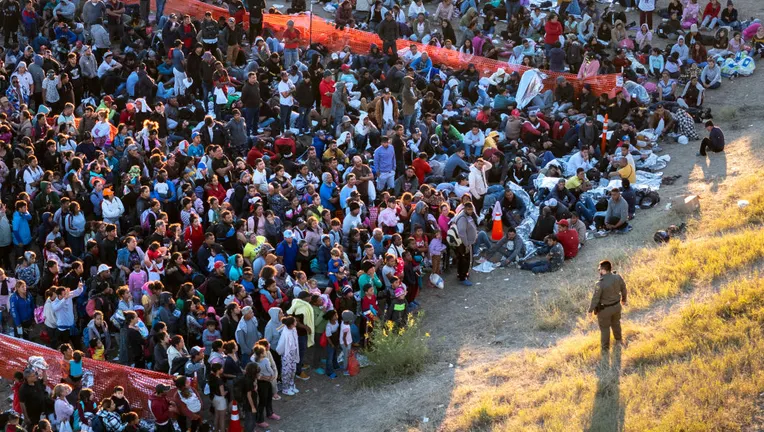
The Border Patrol recorded 1,659,206 southwest border encounters in fiscal year 2021, 2,206,436 in 2022, 2,045,838 in 2023 and 1,530,523 in 2024. Encounters represent enforcement events rather than unique individuals because some migrants attempt to cross more than once, but the scale remained historically extraordinary.
A Pew Research Center analysis built from Customs and Border Protection statistics found that the 2022 total was the highest annual figure in the historical series. The 2021 and 2023 totals also exceeded two previous peaks recorded in 2000 and 1986.
The numbers began falling during Biden’s final year after the United States and Mexico increased enforcement cooperation and the administration imposed stronger asylum restrictions in June and September 2024. The decline accelerated after Trump returned to office, terminated several Biden-era entry programs, restricted access to asylum at the southern border and increased the perceived likelihood that an illegal crossing would end in detention or removal rather than release.
Border Patrol recorded 237,538 encounters at the United States-Mexico border during fiscal year 2025, the lowest annual total since 1970. The decline began before Trump took office, but monthly encounters fell substantially further during his second administration.
That sequence demonstrates that migration flows respond to policy signals, Mexican enforcement, access to asylum procedures, detention capacity and the perceived probability of being released into the United States. Economic and political conditions abroad influence migration, but the border totals were not produced by forces beyond governmental control.
The Biden administration eventually adopted restrictions that it had resisted during the earlier years of the surge. By the time the policy changed, millions of encounters had already occurred, immigration courts were overwhelmed, state and local governments were absorbing new costs, and public trust in the administration’s ability to enforce the border had collapsed.
How Federal Screening Failed Before Kayla Hamilton’s Murder
Martinez entered the United States as an unaccompanied child from El Salvador. Federal law generally requires minors from countries other than Mexico and Canada to be transferred from the Department of Homeland Security to the Department of Health and Human Services while their immigration proceedings continue.
The Office of Refugee Resettlement is responsible for caring for those children and identifying sponsors. Existing procedures can involve public record checks, sex offender registries, child abuse records, immigration databases and fingerprint-based criminal history searches. The extent of those checks has historically depended on the sponsor’s relationship to the child and the risks identified in the individual case, as HHS inspector general findings and GAO oversight reports have documented.
Those procedures did not uncover the information later identified in Martinez’s case. The House Judiciary staff report said he had previously been arrested in El Salvador for illicit association with MS-13, while American investigators later observed gang tattoos that had not appeared in his federal placement files.
The full details of his federal processing record have not been released publicly, which limits independent review. The confirmed sequence remains severe. Martinez entered illegally in March 2022, was processed as an unaccompanied child, reached Maryland and murdered Hamilton four months after crossing the border.
The House passed the Kayla Hamilton Act in December 2025 by a vote of 225 to 201, with every voting Republican and seven Democrats supporting it. The legislation would expand criminal and gang record checks for unaccompanied children, require consultation with authorities in their countries of origin and impose additional restrictions on placements with certain sponsors.
A Senate version introduced as S. 3054 was referred to the Senate Committee on Health, Education, Labor and Pensions. Supporters argue that the bill would close screening failures exposed by Hamilton’s murder, while opponents contend that its provisions could prolong the detention of children, prevent placement with otherwise safe relatives and rely too heavily on foreign records or tattoos as evidence of gang membership.
Those disagreements deserve scrutiny, but the underlying failure cannot be dismissed. A system responsible for protecting unaccompanied children must also determine whether an older teenager has a violent criminal history or active gang affiliation before placing him in an American community. Humanitarian protection and public safety are not competing obligations when the screening system is functioning properly.
Bush Admitted the Border Was Out of Control and Still Left It Unresolved
President George W. Bush openly acknowledged that the federal government had failed to control the border. In a 2006 address from the Oval Office, he said the United States had not maintained complete control of its borders for decades and described forged employment documents, pressure on public institutions and crime connected to illegal immigration.
Bush proposed more Border Patrol agents, National Guard assistance, physical barriers, stronger employment verification and faster returns for people caught entering illegally. He also supported a temporary worker program that would match foreign workers with American employers and create a process through which some established unauthorized immigrants could obtain lawful status after meeting specified conditions.
The proposal captured the Republican Party’s enduring contradiction. The administration wanted stronger enforcement, continued access to immigrant labor and a political settlement for millions of people already living in the country illegally. Each objective complicated the others, and Congress never enacted the comprehensive agreement Bush sought.
Bush did oversee a significant expansion of physical infrastructure. The Secure Fence Act and later appropriations helped increase primary southwest border fencing from 119 miles in fiscal year 2005 to 654 miles by fiscal year 2015. A GAO assessment of that construction found that the total included 354 miles of pedestrian fencing and 300 miles of vehicle barriers.
Much of the construction was completed by 2009, but the infrastructure did not create operational control across the full southwest border. Bush also left office without universal employment verification, a durable employer enforcement system or an immigration court structure capable of resolving the growing caseload.
The administration understood every major component of the crisis. It identified illegal employment, insufficient personnel, weak barriers, fraudulent documents and the lack of legal labor channels, but it failed to produce a system in which those pieces operated together.
Trump’s First Wall Promise Exceeded What His Administration Completed
Donald Trump entered office in 2017 after making a border wall the physical symbol of his campaign. His administration replaced weak vehicle barriers with much taller pedestrian barriers, constructed new sections and used military funding after Congress refused to provide the full amount he requested.
Between January 2017 and January 2021, the Departments of Homeland Security and Defense installed approximately 458 miles of barrier panels. A Government Accountability Office review found that 81 percent of those miles replaced existing barriers, leaving approximately 87 miles installed in locations where no previous barrier had stood.
Replacement construction still had substantial operational value. Replacing low vehicle barriers with tall steel bollards changed what the structure could stop and made illegal pedestrian crossings more difficult in those areas. Describing the entire 458 miles as wholly new wall, however, concealed the amount that replaced prior infrastructure.
The wall system also involved more than steel panels. Roads, lighting, cameras, sensors and other technology were required to turn a barrier into a complete enforcement system. A separate GAO review of construction contracts found that only about 15 percent of the installed panels formed complete barrier systems by January 2021.
Trump did not fulfill his first-term promise to seal the southwest border. Congressional resistance, litigation, private land acquisition, contracting delays and the administration’s own execution contributed to the unfinished result.
His second-term record nevertheless demonstrates that illegal crossings can be reduced drastically without completing a wall across the entire border. Fiscal year 2025 produced the lowest Border Patrol encounter total in more than 50 years, following a combination of enforcement changes begun during Biden’s final year and expanded after Trump returned to office.
The first Trump administration failed to complete the physical and institutional system it promised. The second demonstrated that the expectation of detention, restricted asylum access and removal can alter migration behavior quickly. Both parts of that record are necessary for an honest judgment.
MS-13 Is a Transnational Criminal Organization, Not a Political Abstraction
MS-13 is a specific transnational criminal organization with identifiable leaders, local cliques, recruitment systems and command relationships. Treating the gang as merely a campaign slogan ignores documented murders, extortion, drug trafficking, witness intimidation and communication between American members and leaders in El Salvador.
In April 2026, the Justice Department announced sentences for eight Salvadoran MS-13 members who had lived illegally in the Houston area. They had pleaded guilty to participating in a racketeering conspiracy involving multiple murders and witness tampering.
The criminal enterprise killed victims as young as 14. Prosecutors established that some of the murders were directed by gang leaders in El Salvador and that participants sent photographs of the victims’ bodies to those leaders after the killings.
The case demonstrates how a transnational gang can use migration routes, local networks and communications with foreign leadership to sustain violence inside the United States. It also shows why immigration screening must be connected to foreign criminal records and intelligence rather than limited to databases containing only American arrests.
The existence of MS-13 does not establish that Salvadorans, Central Americans or residents of immigrant neighborhoods are collectively dangerous. Immigrants living in communities where the gang operates are frequently among its first victims because members can exploit language, family connections and fear of retaliation.
Refusing to investigate gang networks for fear of stigmatizing a community abandons the people most likely to be recruited, extorted or murdered. Treating an entire ethnic community as criminal would be equally destructive because it would discourage witnesses from cooperating and replace evidence with ancestry.
Haitian-Linked Gangs Require Facts Rather Than Exaggeration
Haitian criminal organizations and Haitian-linked American street gangs are documented realities, but they are not a single unified movement. Domestic gangs operating in Florida must also be distinguished from armed organizations controlling territory inside Haiti.
In May 2025, federal prosecutors announced convictions and prison sentences for 18 members of violent South Florida street gangs, including Zoe Mafia Family, the 3rd World gang and several Bloods factions. The cases involved firearms offenses and trafficking in fentanyl, methamphetamine and cocaine.
The Haiti-based organization 400 Mawozo presents a different transnational threat. Its former leader, Joly Germine, received a 35-year federal sentence in June 2024 for participating in a conspiracy that purchased and smuggled firearms from the United States into Haiti while laundering ransom money obtained from American hostages.
A federal jury later convicted Germine for organizing the 2021 kidnapping of 16 American missionaries and one Canadian citizen. He received a life sentence in December 2025 for the hostage-taking conspiracy, creating a separate punishment from his earlier gunrunning sentence.
These cases demonstrate genuine connections between American firearms markets, narcotics trafficking, ransom payments and Haitian criminal organizations. They do not establish that Haitian immigrants generally belong to gangs or that recent Haitian arrivals form a single criminal enclave.
Immigration authorities should identify gang members and associates through criminal records, intelligence sharing, financial investigations and verified evidence. Local police should investigate domestic gangs without suppressing facts because of political sensitivities, but public officials should not use unrelated cases to make unsupported claims about an entire nationality.
Lower Average Crime Rates Do Not Erase Preventable Murders
Serious analysis must address the strongest evidence that complicates the political argument. Available research does not show that unauthorized immigrants, as a population, commit violent crimes at a higher rate than people born in the United States.
A peer-reviewed study published by the Proceedings of the National Academy of Sciences used Texas Department of Public Safety data to compare felony arrest rates among unauthorized immigrants, legal immigrants and native-born citizens from 2012 through 2018. The researchers found lower arrest rates among unauthorized immigrants across violent, property and drug offenses.
Texas offers unusually detailed data because state records can be matched with federal immigration information. The study remains limited to one state and measures arrests rather than every crime committed, but its findings provide no factual basis for claiming that every illegal immigrant is violent or that illegal immigration automatically produces a higher national crime rate.
Population averages do not resolve the policy failure exposed by Hamilton’s murder. Statistical rates cannot determine whether Martinez should have been released, whether his Salvadoran gang record should have been discovered or whether the screening process functioned properly in his individual case.
An offender can belong to a population with a comparatively low average crime rate and still commit a murder that would not have occurred in Maryland had the government detected his record and prevented his release. The lower overall rate does not restore Hamilton’s life or eliminate the government’s responsibility to screen the individual standing before it.
Political leaders frequently select only the evidence that benefits their party. Some Democrats cite aggregate crime studies as though those studies answer every question about screening, detention and removal. Some Republicans cite individual murders as though they establish that millions of illegal immigrants are violent. A functioning government must understand population-level evidence while still preventing identifiable dangerous individuals from entering American communities.
The Democratic Failure Became Moral as Well as Administrative
The deepest Democratic failure was not the decision to protect genuine refugees, exploited workers or unaccompanied children. Those are legitimate governmental responsibilities, and abandoning them would expose vulnerable people to trafficking, persecution and abuse.
The failure came from allowing humanitarian concerns to overwhelm the equally important obligation to distinguish lawful immigration from illegal entry, valid asylum claims from unsupported applications, vulnerable children from gang-affiliated teenagers, and settled residents from recent arrivals whose identities could not be adequately verified.
During the Biden years, major parts of the Democratic coalition became more practiced at describing the harms caused by immigration enforcement than the harms caused by its absence. Deportation was discussed through the suffering of the person removed. Detention was discussed through conditions inside federal facilities. Border barriers were discussed through environmental and humanitarian costs. Cooperation with immigration authorities was discussed through its effect on trust between police and immigrant communities.
Each concern contained legitimate issues, but their combined political effect weakened the idea that enforcement itself served a moral purpose. A government has obligations to citizens, lawful immigrants, border communities and the migrants endangered by smugglers and gangs. Disorder can harm every one of those groups.
Hamilton’s family paid one of those costs. Immigrant families extorted by MS-13 paid another. Unauthorized workers cheated by employers and children placed in dangerous jobs were also victims of a system that tolerated illegality while claiming compassion.
A policy cannot measure its humanity only by the hardship imposed on the person being detained or removed. It must also account for the people harmed when screening fails, removal orders are ignored, criminal records remain undiscovered and gangs exploit the same communities political leaders claim to protect.
The Republican Failure Was Economic and Institutional
Republicans have generally used harsher language about illegal immigration, but they repeatedly stopped short of dismantling the economic structure that makes it profitable. Their governing record contains major enforcement initiatives alongside persistent reluctance to punish the employers and industries that create the job magnet.
Reagan signed legalization before the employer enforcement system had demonstrated that it could prevent the next unauthorized population from developing. George H. W. Bush expanded legal immigration without repairing that system. George W. Bush acknowledged that the border was not controlled while pursuing another bargain involving enforcement, guest workers and legal status. Trump constructed stronger barriers but left much of his first-term wall system incomplete.
Congressional Republicans have repeatedly promoted E-Verify, but the United States still does not require every private employer nationwide to use it. Agriculture, construction, hospitality, food production and other industries continue to exert substantial political influence because abrupt enforcement would disrupt their labor models and raise costs.
Politicians who demand mass deportations rarely explain why employers who knowingly assembled unauthorized workforces should escape criminal accountability. Removing workers while leaving the hiring structure untouched allows companies to recruit replacements and guarantees that the same incentives will survive the next election.
The Republican contradiction is therefore different from the Democratic one. Democratic administrations have increasingly limited enforcement through humanitarian priorities and administrative discretion. Republican coalitions have promised enforcement while repeatedly failing to impose a universal employment system and sustained penalties on businesses that benefit from illegal labor.
The worker is politically visible because he can be arrested in a raid. The executive who designed the hiring structure is less visible, has legal representation and may have influence over the politicians writing the law.
A Government Serious About Prevention Must Change the Structure
A serious immigration policy must begin with employment because jobs remain the strongest long-term incentive for illegal migration. Congress should require a universal, fraud-resistant employment verification system for new hires while giving citizens and authorized workers a rapid procedure for correcting government errors.
Employers who deliberately hire unauthorized labor through fraudulent documents, subcontractors, shell companies or repeated evasions should face penalties large enough to eliminate the financial benefit. Executives and labor brokers who organize systematic schemes should face criminal prosecution when the evidence establishes knowing and repeated violations.
The same system should protect workers who report wage theft, trafficking, child labor and dangerous conditions. Enforcement directed only at employees strengthens abusive employers by allowing them to threaten workers with deportation and replace them after every raid.
The federal government should also build a national data system for serious crimes committed by noncitizens. The system should distinguish lawful permanent residents, visa holders, asylum applicants, visa overstays, recent illegal entrants and people subject to final removal orders. Public reporting should rely on convictions, clearly separate immigration offenses from violent crimes and avoid releasing identifying information unrelated to legitimate public oversight.
Unaccompanied children should receive protection appropriate to their age, but older teenagers should undergo meaningful checks for foreign criminal records, gang affiliation and prior violent conduct. Sponsors and adult household members should be screened consistently, while disputed foreign records and alleged gang markings should receive individual review rather than automatic acceptance.
Immigration courts require enough judges, staff and interpreters to resolve claims within a reasonable period. People with valid asylum or humanitarian claims should receive decisions promptly. People whose claims fail after due process should be removed rather than allowed to remain until enforcement becomes politically or practically impossible.
Border infrastructure should reflect operational need rather than campaign imagery. Some regions require tall pedestrian barriers, while others require roads, lighting, cameras, sensors, aircraft, river access and enough agents to respond rapidly. A wall without personnel and technology can be breached, while surveillance without detention and removal capacity merely documents the government losing control.
Gang enforcement should combine federal racketeering prosecutions, foreign intelligence, financial investigations, witness protection and cooperation with immigrant communities. The objective should be to separate criminal organizations from the populations they exploit and to remove gang members before they can establish deeper local networks.
These measures would be strict, but they would also be more coherent than a system that alternates between mass release and highly publicized raids while leaving employers, courts, screening systems and national crime data largely unchanged.
Washington Understood the Failure and Chose Not to Finish the Work
The United States did not arrive at its immigration crisis because elected officials failed to understand the problem. Reagan identified illegal employment as the central incentive in 1986. Clinton described the costs of unlawful entry and unauthorized work in 1995. Bush admitted in 2006 that the country had lacked complete control of its borders for decades. Obama acknowledged that undocumented workers had broken immigration law while narrowing enforcement priorities. Trump made border control the defining promise of his political movement.
Every administration possessed part of the diagnosis, but none built a durable system that held every powerful participant accountable at the same time. Democratic administrations increasingly protected broad categories of removable residents from enforcement. Republican governments attacked illegal entry without consistently confronting employers and industries that depended on unauthorized labor.
Congress expanded legal pathways and humanitarian protections more reliably than it funded immigration courts, screening, verification, detention and removal. Presidents changed enforcement priorities through executive action, teaching migrants, smugglers and employers that the practical meaning of immigration law could change after the next election.
Kayla Hamilton’s murder does not establish that immigrants are inherently violent. It establishes a narrower and more damaging truth. A young MS-13 member entered the country illegally, passed through the federal system, reached an American community and murdered a vulnerable woman four months after crossing the border.
The government still has not released a complete public explanation of how its safeguards failed. It also cannot determine how many comparable killings have occurred since Washington promised in 1986 that legalization would be paired with control.
The absence of reliable national data protects politicians from accountability. Weak workplace enforcement protects employers from disruption. Incomplete screening protects bureaucracies from having to explain what they failed to discover. Partisan exaggeration then allows both parties to substitute outrage for institutional reform.
The country requires a government capable of determining who enters, who remains, who must leave and who profits from violating the law. For four decades, Washington repeatedly identified the problem, announced another solution and left the essential work unfinished.