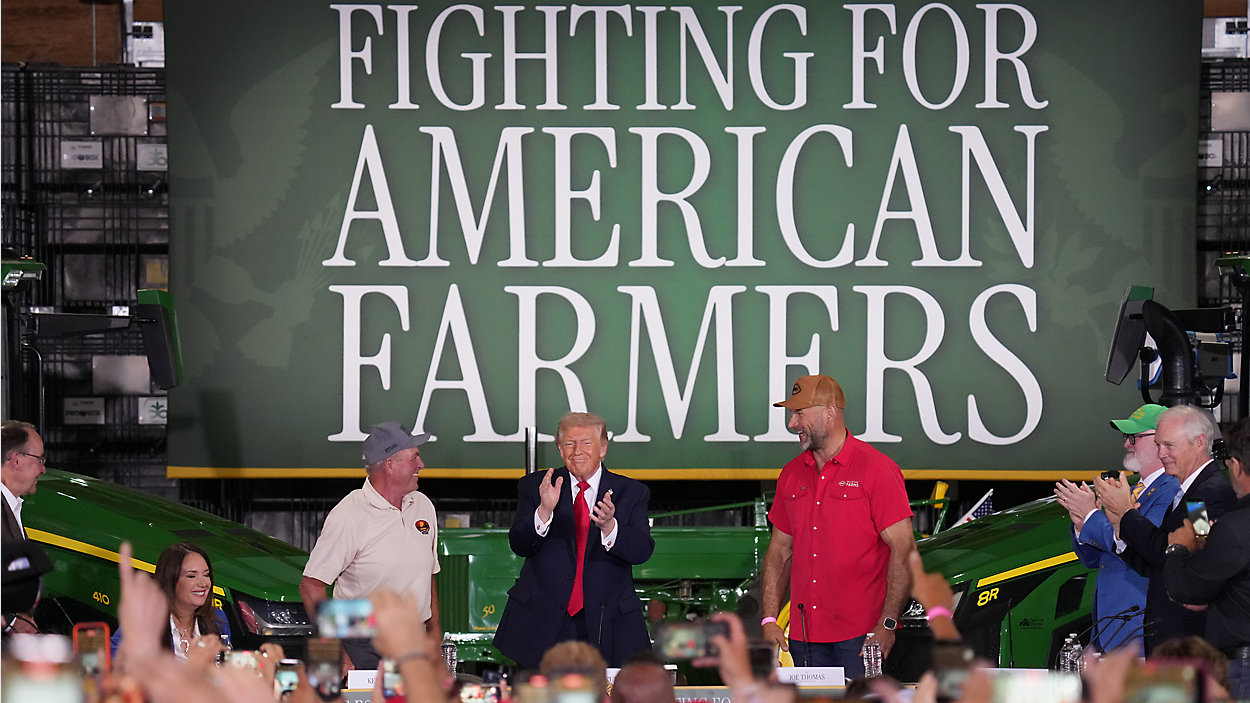
John Rich’s new government title sounds like something built for a cable news chyron: Special Envoy for American Landowners. The country singer, businessman and longtime Trump ally announced that he would be sworn in by President Donald Trump in the Oval Office, thanking him for the chance to “fight for my fellow Americans.” The Department of Agriculture had already framed Rich as a “leading advocate” for farmers, ranchers and private landowners, especially those resisting government overreach, activist pressure campaigns and large scale wind and solar projects on farmland.
That official description tells only part of the story. Rich is stepping into Trump’s orbit at a moment when agriculture has become one of the most revealing pressure points in the president’s immigration agenda. Trump promised mass deportations. Farmers warned that the food system could not survive if the workers who pick crops, milk cows, pack meat and process food were swept out in large numbers. Then Trump began floating exceptions, pauses, temporary passes and farmer driven recommendations for workers who had been in the country illegally but had become essential to the farms employing them.
The result is the kind of contradiction Washington usually hides behind softer language. Trump wants the politics of mass deportation without fully absorbing the economic cost of deporting the labor force that agriculture has built itself around. Rich’s appointment does not make him the architect of immigration policy. There is no public evidence that he has a formal role in deportation decisions, H-2A visa policy or employer enforcement. But his new title gives agricultural interests another friendly voice near Trump, and that matters because Trump has already shown he listens when farmers say enforcement is hurting them.
Who John Rich Is, and Why Trump Knows Him
Rich is not a career agriculture official, immigration lawyer or labor economist. He is a country music figure who moved from Lonestar into Big & Rich, built a solo career and later attached his public brand to patriotism, conservative politics and rural grievance. His own public biography describes him as a former Lonestar member and Big & Rich performer whose career stretches back decades in Nashville.
His connection to Trump is older than Trump’s presidency. In 2011, Rich won The Celebrity Apprentice, beating Marlee Matlin and winning $250,000 for St. Jude Children’s Research Hospital. That put him inside Trump’s reality television universe years before the Republican Party was remade around Trump’s political instincts.
Rich later became part of the wider Trump cultural world. He appeared around Trump aligned events, built a conservative media presence and remained close enough to the movement that USDA Secretary Brooke Rollins placed him beside senior officials and farming families when the department launched its Farmer and Rancher Freedom Framework in February 2026. At that event, Rich spoke the language of rural populism, saying powerful companies and agencies had treated landowners like “lowly peasants” standing in the way of “them, and their billions.”
That is the value Rich brings to Trump. He translates policy into grievance. He turns regulatory fights into moral stories. He gives farmers and ranchers a famous ally who sounds less like a bureaucrat and more like someone speaking from the stage at a county fair. In Trump world, that kind of messenger can matter more than a formal résumé.
The Official Job Is About Land, But the Politics Are Bigger
USDA says Rich will advocate for landowners whose rights are threatened by federal overreach, outside pressure and energy development. The department specifically says a key part of his work will involve landowners facing pressure from large scale solar and wind development that could affect farmland, ranchland and rural livelihoods.
On paper, that is a property rights role. In practice, farmland cannot be separated from labor. The landowner who complains about a transmission line may also rely on migrant workers. The rancher who opposes federal regulation may also need a legal workforce pipeline. The grower who wants Washington to stop taking land may also want Washington to stop taking workers.
That is why Rich’s role sits next to the immigration fight even if USDA did not present it that way. Agriculture is not just land, tractors and barns. It is labor. The political class often celebrates the farmer while ignoring the people bent over in the field, and Trump’s immigration policy has forced that hidden dependency into public view.
USDA’s Economic Research Service says that in 2020 to 2022, 42 percent of hired crop farmworkers lacked work authorization. The same USDA labor overview notes that the H-2A guest worker program has expanded dramatically, with certified positions rising from just over 48,000 in fiscal 2005 to about 385,000 in fiscal 2024. But even that program has limits. USDA explains that H-2A is seasonal, usually capped at 10 months, and that most livestock producers, including dairies, hog operations and poultry operations, cannot use it for year round labor needs.
That is the real structure behind the political noise. American agriculture depends heavily on foreign born labor, a large share of that labor has been unauthorized, and the legal guest worker system does not cleanly match how the modern food economy works.
Trump’s Deportation Promise Ran Into the Food Supply
Trump’s second term immigration message was built around force: deport more people, close the border, restore interior enforcement and make the spectacle of removal part of the governing brand. Then agriculture started warning that the spectacle had consequences.
In April 2025, Trump suggested that farmers might be allowed to petition the government to keep certain workers who lacked legal status, with those workers eventually leaving and returning through a legal process. Reuters described the comments as the administration’s most detailed signal at that point on undocumented farmworkers, with Trump saying farmers could provide letters for workers who were “great” and “working hard” while the government would “slow it down a little bit” for them before a legal return process. Reuters also noted that farm groups had warned mass deportations could grind the food system down.
By June, the problem had become harder to hide. The Associated Press reported that the Trump administration directed immigration officers to pause arrests at farms, meatpacking plants, hotels and restaurants after Trump expressed alarm that aggressive enforcement was taking away long time workers from industries where replacement labor was difficult to find. Trump wrote that farmers and hotel operators were losing “very good, long time workers” and that “changes are coming.”
The pause did not settle the issue. AP later reported that Trump directed ICE to expand deportations in large Democratic run cities while enforcement was simultaneously being eased in sectors such as farms, restaurants and hotels. In other words, the administration was not abandoning mass deportations. It was steering them away from some politically sensitive employers while intensifying pressure elsewhere.
That is the essential political bargain. Trump can sound absolute on immigration at a rally, then soften the blow for industries whose owners have access, lobbyists and economic leverage. The workers remain vulnerable. The employers remain protected by necessity.
The Government Admitted the Quiet Part
The clearest evidence of the contradiction came not from a liberal advocacy group, but from Trump’s own Labor Department.
In October 2025, the Department of Labor issued an interim final rule changing how wages are calculated for H-2A agricultural guest workers. Buried inside the Federal Register filing was a remarkable admission: the “near total cessation” of illegal inflows, increased immigration enforcement and global competition created a risk of food supply shocks. The department said the lack of available legal labor threatened domestic food production and prices for consumers.
The filing went further. Labor officials wrote that much of the illegal inflow had “artificially boosted” the labor supply at lower costs compared with a legal workforce, and that agriculture employers were facing severe challenges because roughly 42 percent of crop workers surveyed in 2021 and 2022 lacked authorization to work in the United States.
That is the sentence that exposes the whole system. For years, political leaders denounced illegal immigration while American agriculture benefited from workers who could be paid less, threatened more easily and replaced with little political cost. When Trump enforcement actually began to threaten that arrangement, the same administration that promised a hard line started looking for ways to preserve the labor supply.
The Labor Department also said American workers were not likely to fill the gap in sufficient numbers. The filing stated that domestic applicants were not applying for agricultural jobs in numbers sufficient to meet employer demand and that qualified eligible U.S. workers would not make themselves immediately available to replace the departing unauthorized workforce. That is not an outside critic mocking Trump’s policy. That is the federal government explaining why agriculture cannot simply deport its way into an all American farm workforce.
The H-2A Fix Still Protects the Employer First
The administration’s answer has been to push agriculture toward more legal foreign labor, especially through H-2A. That sounds clean until the details matter.
USDA says H-2A employers must show they cannot find enough U.S. workers, must pay at least the required wage floor and must provide housing and transportation. The same USDA labor overview shows the program has grown more than sevenfold over 19 years, reaching about 385,000 certified positions in fiscal 2024. But H-2A workers are tied to the employer who sponsors them, making them far less free than ordinary workers in the labor market. A worker who depends on one employer for legal status, housing and continued employment has limited leverage.
The October 2025 Labor Department rule moved the wage system toward a new methodology using Bureau of Labor Statistics wage data, while also creating a standard adjustment for employer provided housing. The Federal Register filing acknowledged that some current H 2A workers may experience wage reductions as a result of lower prevailing wage rates.
That means the administration’s practical response to farm labor shortages is not simply “legal labor.” It is legal labor under conditions designed to keep farmers’ costs down. Trump can say he is restoring order at the border while his agencies help agricultural employers replace unauthorized workers with a guest worker system that remains highly employer controlled.
That may be politically brilliant. It is also revealing. The worker is treated as the problem when he crosses illegally, then becomes essential when the farmer needs him, then becomes acceptable again if the legal structure keeps him temporary, dependent and cheaper than a fully free domestic labor market would require.
Where Greg Abbott and Texas Fit Into the Same Pattern
The same contradiction exists in Texas. Gov. Greg Abbott has built a national profile on border security, migrant buses, state enforcement and Operation Lone Star. But Texas has not required most private employers to use E-Verify, the federal system that checks whether new hires are authorized to work.
Abbott signed a 2015 law requiring Texas state agencies to use E Verify, saying taxpayer funded state paychecks should go only to workers eligible to work in the United States. But the requirement stopped far short of the private economy. The Texas Tribune and ProPublica reported in 2025 that Texas still instructs only state agencies and sexually oriented businesses to use E-Verify, while proposals to require all private employers to participate have repeatedly failed. The same investigation noted that Abbott, despite positioning Texas as tougher on immigration than many states, had not made a private employer E Verify mandate a legislative priority.
That matters because employer enforcement is where immigration politics becomes economically serious. It is one thing to send National Guard troops to the border. It is another thing to tell construction companies, farms, restaurants, meat processors, hotels and subcontractors that every new worker must clear electronic verification, with real penalties for employers who evade the law.
Federal law already makes it unlawful to knowingly hire or continue employing unauthorized workers. The U.S. Code states that employers may not knowingly hire unauthorized workers and may not continue employing a worker once they know that person is unauthorized. The weak point has always been enforcement against the employer side. Workers get detained. Employers often absorb the disruption, complain about labor shortages and wait for the next workaround.
That is the Abbott problem and the Trump problem at the same time. Border enforcement is politically loud. Employer enforcement is economically dangerous. The people who benefit from cheap labor are often closer to power than the workers who provide it.
Rich’s Network Is the Point
Rich’s most important “friends” in this story are not hidden figures. They are visible in the public record: Trump, Brooke Rollins and the agriculture aligned officials around the administration’s rural agenda.
Rollins is especially important. USDA’s own biography says she served during Trump’s first administration as director of the Domestic Policy Council and assistant to the president for strategic initiatives, then founded and led the America First Policy Institute before becoming Secretary of Agriculture. She is not merely a cabinet secretary who happens to serve under Trump. She is part of the Trump policy network that kept his agenda alive between administrations.
When Rollins launched the Farmer and Rancher Freedom Framework, she did so with Rich, HUD Secretary Scott Turner, Representative James Comer and farming families at her side. USDA’s announcement said the framework would protect producers, preserve land and liberty, purge burdensome regulations and partner for agriculture’s future. It also credited work with Rich and Tennessee stakeholders for preventing the Tennessee Valley Authority from seizing productive farmland in Cheatham County for a gas plant.
That gave Rich a policy lane before his formal envoy title. He had already become a celebrity advocate inside a USDA message built around landowners, farmers, rural grievance and anti bureaucracy politics. The immigration connection is not that Rich personally controls farm labor policy. The connection is that he is now another agriculture friendly messenger with access to a president who has already softened enforcement when farmers and hospitality operators complained.
The more voices like that Trump puts around himself, the more likely agriculture gets carved out from the harshest version of his immigration agenda. The worker still gets used as the symbol of illegality. The employer gets treated as a victim of labor disruption.
The Employer Side of Immigration Rarely Gets the Same Fury
The immigration debate usually centers on the border crosser, not the person who hires him. That imbalance is not accidental. The worker is politically easy to punish. The employer is part of the donor class, the local chamber, the farm bureau, the construction network, the hotel group, the restaurant association or the rural political machine.
That imbalance has existed for decades. The Immigration Reform and Control Act of 1986 created employer sanctions while also legalizing millions of unauthorized immigrants. The employer sanction system was supposed to remove the jobs magnet from illegal immigration. But the modern economy learned to live with paperwork, subcontracting, labor contractors, plausible deniability and selective enforcement.
Agriculture became one of the clearest examples. A grower can condemn illegal immigration in public while depending on unauthorized labor in practice. A politician can campaign against illegal workers while avoiding the employer mandate that would force his own business allies to change. A president can promise the largest deportation operation in history, then pause enforcement when farmers warn that the crops will rot or the dairy cannot run.
Rich’s appointment belongs inside that world. He gives voice to landowners as landowners. But in the real agriculture economy, landowners are also employers, contractors, lobbyists and political actors. Some are victims of government overreach. Some benefit from a labor system that keeps workers vulnerable. Both things can be true in the same industry, sometimes on the same farm.
The Real Question Rich Raises
The fair question is not whether John Rich has the legal power to stop deportations. He does not appear to have that power. The fair question is whether his appointment adds one more pressure point pushing Trump toward the farmer exception: tough immigration rhetoric for the crowd, softer treatment for politically connected industries that rely on cheap foreign labor.
The evidence already points in that direction. Trump floated a farmer petition process. He talked about temporary passes. His administration paused enforcement at farms and hospitality businesses after industry alarm. His Labor Department admitted that removing unauthorized workers from agriculture threatens food production and prices. His USDA elevated a country singer and landowner advocate into an official role representing farmers and ranchers.
That combination deserves scrutiny. If Washington is going to enforce immigration law, then the employer side cannot remain protected by political friendship. If the government believes agriculture needs foreign workers, then it should build a lawful system that does not trap workers in dependency or quietly reward years of illegal hiring. If Trump is going to claim that farmers are the backbone of the country, he should also admit that many of those farms have been standing on the backs of unauthorized workers.
Rich may end up spending most of his time on land disputes, solar projects, wind farms and eminent domain cases. That is the official job. But his rise still reveals the larger Trump pattern. The president likes blunt symbols, famous loyalists and people who can bring him the complaints of a favored constituency in language he understands. Farmers now have another one of those people in the room.
The danger is not that John Rich alone will write immigration policy. The danger is that the loudest voices in Trump’s ear will keep finding ways to protect the employer while the worker takes the blame.