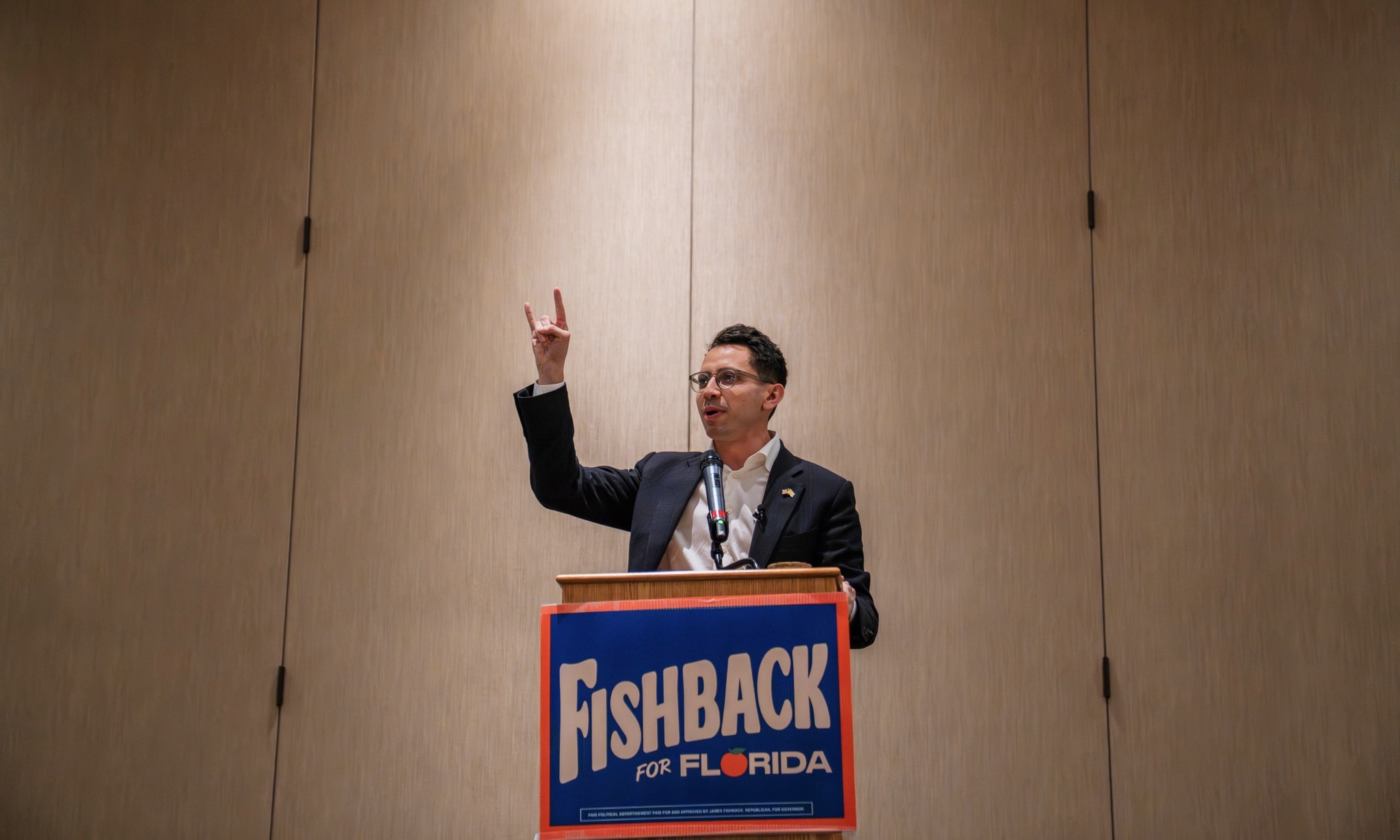
James Fishback is unlikely to become the next Donald Trump. He may be something more revealing: a measure of what Trump’s movement has produced beneath the surface of the Republican Party.
The 31 year old investment manager entered the Florida governor’s race without Trump’s celebrity, money or institutional support. He is challenging Byron Donalds, a congressman endorsed by Trump and embraced by much of the Republican establishment. Fishback has instead built his campaign around young men, economic nationalism, immigration restriction, opposition to foreign intervention and increasingly aggressive attacks on America’s political relationship with Israel.
The statewide numbers remain daunting. A June survey of likely Republican primary voters placed Donalds at 54 percent and Fishback at 8 percent, although the poll was sponsored by Associated Industries of Florida, an organization that endorsed Donalds. An earlier Emerson College survey placed Fishback at 4 percent.
Yet Fishback’s support has not been evenly distributed. A University of North Florida poll examined by WUSF found him drawing 32 percent among likely Republican primary voters between the ages of 18 and 32, while registering below 1 percent among voters older than 55. The subgroup was small enough to require caution, but the disparity was too large to dismiss as ordinary statistical noise.
Fishback may lose the Florida primary on August 18. His candidacy could still mark the beginning of a struggle over who inherits the rebellion Trump began and whether the next generation of the American right will remain loyal to the alliances, donors and foreign policy commitments that Trump ultimately preserved.
A Candidate Built From the Contradictions of MAGA
Fishback presents himself as a native product of Florida rather than a professional politician manufactured in Washington. His official campaign biography describes him as a fourth generation Floridian raised in Broward County by a Colombian immigrant mother and a father who operated a tree trimming business. His family relied on food stamps, he says, and he overcame a childhood stutter through competitive debate before studying international economics at Georgetown University and entering finance.
The biography is carefully constructed for the politics of the moment. Fishback is young enough to speak fluently in the language of online conservatism, wealthy enough to present himself as independent and culturally rooted enough to reject the polished corporate vocabulary that dominates conventional campaigns.
He is also running against the official heir to Trump’s Florida coalition. Donalds has Trump’s endorsement, substantial financial backing and a commanding polling lead. Fishback has responded by arguing that MAGA has become another managed political brand, one increasingly controlled by donors, consultants and elected officials who speak in Trump’s language while governing within the old Republican order.
At a June rally covered by WLRN, Fishback promised to “burn down the Republican establishment.” The crowd numbered roughly 200 people and was composed largely of young men, the demographic at the center of his strategy.
That strategy reflects a central contradiction within MAGA. Trump transformed the Republican electorate but did not build a coherent ideological system to govern it. His coalition contained traditional business conservatives, evangelical Christians, immigration restrictionists, libertarians, working class populists, foreign policy hawks and antiwar nationalists. The factions remained together because Trump himself remained the movement’s organizing force.
Fishback is campaigning for the period when personal loyalty to Trump may no longer be sufficient to contain those disagreements.
Economic Nationalism Without Reagan’s Restraints
Fishback’s platform would have been almost unrecognizable in the Republican Party that existed before Trump.
He proposes banning private equity firms, foreign nationals and short term rental investors from purchasing single family homes in Florida. He wants to abolish property taxes on primary residences, provide $10,000 in down payment assistance to young married couples, increase teacher salaries by 25 percent, eliminate toll roads and offer large state funded prizes for innovations that could restore Florida’s citrus industry. His campaign also supports paid maternity leave, restrictions on data centers and a state official devoted to protecting small businesses.
This is not the language of limited government conservatism. It is an argument for using state power to protect families, workers, homeowners and strategically important industries from concentrated capital and foreign competition.
Some of the proposals would require far more than a governor’s order. Florida’s homestead tax system is embedded in state law and the Florida Constitution. Major constitutional changes must ultimately receive at least 60 percent support from voters. The H 1B visa system Fishback wants to halt is a federal immigration program administered by United States Citizenship and Immigration Services, placing it largely beyond the unilateral authority of a governor.
The legal limitations have not weakened the political message. Fishback is presenting the cost of housing, declining family formation, technological displacement and labor competition as connected parts of a single national crisis. His argument is that economic policy should serve the continuity of the American people rather than abstract measures of growth.
That puts him closer to the emerging populist right than to the Republican Party of Ronald Reagan, Paul Ryan or the Chamber of Commerce. The older party emphasized lower taxes, deregulation and the free movement of goods and capital. Fishback’s campaign treats markets as instruments that may be restricted when they conflict with national or social objectives.
Where the Comparison to Trump Holds
The comparison with Trump in 2016 begins with political style. Both campaigns rely on confrontation, ridicule and the claim that elected Republicans have betrayed their own voters. Both treat condemnation by established media organizations and party leaders as evidence of independence. Both appeal to voters who believe conventional politicians are more frightened of elite disapproval than of losing the country they were elected to defend.
Their substantive overlap is also real. In his June 2015 campaign announcement, Trump connected illegal immigration, trade deficits, industrial decline and political incompetence into a single story about national humiliation. Fishback has updated the formula for a younger audience confronting unaffordable housing, expensive education, insecure employment and diminished faith that hard work will produce a stable family life.
Trump argued that political leaders had sold out the country through bad trade agreements and uncontrolled immigration. Fishback adds private equity landlords, technology companies, foreign home buyers, data centers and the H 1B program to the indictment.
The resemblance is strongest in the way both candidates convert attacks into political fuel. When party institutions exclude Fishback or outside organizations spend money against him, he presents the opposition as confirmation that his campaign threatens powerful interests. A group aligned with Senator Ted Cruz launched a $400,000 advertising campaign against Fishback in July, giving him another national opponent and another opportunity to depict the primary as a contest between voters and political gatekeepers.
Trump used the same dynamic throughout 2015 and 2016. Each controversy produced more coverage, and each attempt to disqualify him strengthened his bond with voters who already distrusted the institutions attacking him.
Where the Trump Comparison Fails
The polling difference is decisive.
Trump began his 2016 campaign as an unconventional candidate, but he did not remain a marginal one for long. He rose from approximately 1 percent as the first choice of Republican voters in March 2015 to 44 percent by April 2016, as documented by the Pew Research Center’s reconstruction of the primary. By August 2015, a Reuters and Ipsos survey placed him at 24 percent nationally, while a Monmouth University poll found him leading South Carolina with 30 percent and drawing support across ideological categories.
Fishback has not demonstrated that breadth. His support is concentrated among younger Republicans and the most disaffected parts of the online right. Older voters, who dominate Republican primaries, have shown little inclination to abandon Donalds.
Trump entered politics with decades of national celebrity, almost universal name recognition and an instinctive command of television. Fishback is building recognition through podcasts, online clips and campus appearances. Those platforms can create intense loyalty, but intensity within a narrow audience does not automatically produce a statewide majority.
There is also an ideological break that cannot be ignored. Trump ran in 2016 as an opponent of failed wars and foreign policy elites, but he remained strongly aligned with Israel. He delivered a forceful speech to the American Israel Public Affairs Committee during the campaign, later recognized Jerusalem as Israel’s capital, moved the American Embassy there and helped broker the Abraham Accords.
Fishback is attacking the alliance itself.
Israel Has Become the New Right’s Fault Line
Fishback has pledged to sell Florida’s holdings in Israel bonds and redirect the money toward housing assistance for young families. Florida holds roughly $350 million in the bonds, while Fishback has placed the figure closer to $385 million. These securities are loans purchased as investments, rather than grants or conventional foreign aid, but their political symbolism is unmistakable.
In a January interview with Tucker Carlson, Fishback called Israeli Prime Minister Benjamin Netanyahu “a total criminal” and a “depraved little man.” He criticized AIPAC’s influence over Republican politicians and mocked Donalds as “AIPAC Shakur.” He said his own views hardened after traveling to Israel on a sponsored trip that he later regarded as an exercise in political persuasion.
The language is deliberately provocative, but the underlying position is coherent. Fishback argues that American resources should be used for American families, that Israel should not receive exceptional treatment and that Republican politicians have allowed donors and foreign policy organizations to narrow the limits of acceptable debate.
That argument represents a major departure from Republican politics during most of the past four decades. Support for Israel became a defining commitment of the conservative coalition, reinforced by evangelical voters, national security hawks and donors who viewed the alliance as both strategically and morally essential.
Fishback is betting that younger Republicans no longer feel bound by that history. Many came of age after the Iraq War, the financial crisis and the long deterioration of public trust in government. They are less likely to remember Israel as a small state fighting for survival and more likely to encounter the country through images of destruction in Gaza, arguments over American military assistance and online debates about lobbying influence.
His campaign has turned that generational distance into an explicit political program.
The Generational Shift Is Real, but It Is Not Yet a Republican Majority
Recent polling confirms that views of Israel are changing quickly, particularly among younger Republicans.
An April 2026 Pew Research Center survey found that 60 percent of American adults held an unfavorable view of Israel, an increase of nearly 20 percentage points since 2022. Republicans remained more supportive than Democrats, but 57 percent of Republicans younger than 50 expressed an unfavorable view of Israel. Only 30 percent of Republicans in that age group said they had confidence in Netanyahu, compared with 58 percent among older Republicans.
A later Pew survey conducted in May found that Republicans younger than 30 viewed the Israeli and Palestinian peoples at nearly identical levels. Forty two percent viewed Israelis favorably, while 40 percent viewed Palestinians favorably. Only 28 percent held a favorable view of the Israeli government. Among Republicans overall, favorable views of the Israeli government had fallen from 63 percent in 2024 to 51 percent in 2026.
Gallup found a similar decline. In early 2026, 69 percent of Republicans viewed Israel favorably, still a clear majority but 15 percentage points below the previous year and the lowest Republican rating in more than two decades.
The shift should not be exaggerated. The Republican Party has not become an anti Israel party. An Associated Press and NORC survey found that 60 percent of Republicans believed the level of American support for Israel was about right. Only 13 percent of Republicans described Israel’s actions in Gaza as genocide. A 2025 Gallup poll also found that 71 percent of Republicans approved of Israel’s military campaign in Gaza, even as approval among Americans overall had fallen to 32 percent.
Fishback is therefore campaigning ahead of the Republican median voter. His position is strongest among younger conservatives, while the party’s older and more reliable voters remain broadly supportive of Israel. The question is whether the younger cohort will move toward the existing party consensus as it ages or replace that consensus as it assumes greater influence.
Criticism of Israel and Antisemitism Are Separate Questions
Fishback’s campaign tests the distinction between opposition to Israeli policy and hostility toward Jewish people. That distinction is essential, but Fishback’s own rhetoric has repeatedly made it more difficult to maintain.
Selling Israel bonds, opposing foreign assistance, criticizing Netanyahu and questioning AIPAC’s political power are policy positions. They can be evaluated on their merits without presuming hatred toward Jews. Fishback has also said that religious hostility toward Jewish Americans should be condemned.
At other moments, he has used language carrying racial or antisemitic associations. WLRN documented his use of the term “goyslop,” his description of Donalds as a “DEI Republican” and his repeated racialized mockery of Donalds’ name. The Cruz aligned advertisement highlighted a Fishback statement declaring that “White genocide is real.”
Those statements help explain why the Republican Party of Florida rescinded his invitation to its Sunshine State Showdown. The party cited alleged violations of party rules as well as what it called racist and antisemitic attacks. Fishback interpreted the decision as an effort to protect Donalds and suppress opposition within the party.
Fishback has also argued that Florida’s statutory definition of antisemitism could be used to punish criticism of Israel. The actual statute includes the application of double standards to Israel among possible examples of antisemitism, but it expressly states that criticism comparable to criticism directed at any other country is not antisemitic. It also preserves constitutionally protected speech. The law is used principally within antidiscrimination, education, reporting and monitoring frameworks rather than as a general criminal prohibition on criticism of Israel.
The media and party establishment have sometimes treated Fishback’s policy criticism, provocative language and racial rhetoric as parts of a single package. Fishback benefits politically when those categories are collapsed because he can defend legitimate criticism of Israel while avoiding a direct accounting for the statements that generated the accusations.
A serious evaluation requires separating them.
The Media Attacks May Help Him, but the Trump Story Is Often Misremembered
Fishback has received the kind of coverage that can simultaneously damage and elevate an insurgent candidate. Vox introduced him as a “rage bait candidate”, while other coverage has emphasized racial controversy, antisemitism accusations and his association with the most confrontational corners of the online right. The Associated Press highlighted the Confederate imagery in his launch announcement and the white grievance themes surrounding parts of his message.
Some of the language used to describe him is plainly judgmental. Much of the underlying conduct, however, is documented. Fishback is not being criticized solely because he opposes Israel or challenges Republican donors. His own words provide substantial evidence for the controversy surrounding him.
The comparison to Trump also requires a correction to the conventional memory of 2016. Trump was condemned by editorial writers, rival candidates and many political journalists, but the early coverage of his campaign was not uniformly hostile. A Harvard Shorenstein Center study found that Trump received an extraordinary volume of coverage during 2015 and that the tone was initially favorable enough to help propel his candidacy. His events were broadcast live, his interviews dominated television schedules and his controversies kept him at the center of the campaign.
By the general election, coverage of both Trump and Hillary Clinton had become overwhelmingly negative and heavily focused on controversy rather than policy, another Shorenstein Center analysis found. Trump’s success did not arise simply because the media attacked him. It arose because media institutions treated him as the central figure in American politics, often before they understood the coalition gathering behind him.
Fishback is attempting to reproduce the same feedback loop through a different media system. Instead of depending primarily on cable news, he relies on podcasts, social platforms and viral confrontation. Exclusion from a party event or denunciation from a national politician can become more useful than a traditional endorsement because each conflict supplies evidence for his central story: that powerful institutions are coordinating against him.
The problem for Fishback is that attention has not yet produced Trump’s broad electoral conversion. He has built a recognizable identity, but he has not built a statewide majority.
A Victory Would Rewrite the Republican Coalition
A Fishback victory would be among the most consequential Republican primary upsets of the post Trump era.
It would demonstrate that Trump’s endorsement could be defeated from inside the nationalist right rather than from the party’s moderate wing. It would tell Republican candidates that younger voters are prepared to support aggressive government intervention in housing, labor and family policy. It would also show that opposition to Israel can become a central campaign position rather than an isolated dissent expressed through podcasts or social media.
Such a victory would weaken the authority of the Republican donor class and accelerate a shift away from the foreign policy consensus that united national security conservatives, evangelical Christians and pro Israel organizations for decades. Politicians who currently avoid direct conflict over Israel would begin competing for the voters Fishback had mobilized.
It would also legitimize his political methods. Racial provocation, online insults and deliberate violations of establishment boundaries would become part of the demonstrated path to power rather than a liability that restricted his appeal.
Current evidence does not make that outcome likely. Donalds retains the Trump endorsement, a substantial financial advantage and a commanding position among the older voters most likely to participate in the primary. Fishback also faces an unresolved legal challenge from Lieutenant Governor Jay Collins, who alleges that Fishback failed to satisfy Florida’s seven year residency requirement. Fishback disputes the claim, and a hearing was scheduled for July 21.
A Defeat Could Still Change the Party
The more plausible outcome is that Fishback loses while demonstrating that his issues have an audience larger than his campaign.
Political movements are often previewed by candidates who are unable to consolidate them. Pat Buchanan’s Republican campaigns did not capture the presidency, but his attacks on free trade, immigration and intervention abroad anticipated central components of Trump’s coalition. Ron Paul never won the Republican nomination, but his campaigns created a durable audience for opposition to foreign wars, central banking and the national security state.
Fishback’s possible legacy lies in a similar role. He has connected several sources of conservative discontent that are usually discussed separately: the cost of housing, declining marriage rates, resentment of skilled worker visa programs, distrust of corporations, hostility toward Republican donors and growing opposition to Israel.
Another candidate with greater discipline, stronger financing and less rhetorical baggage could eventually assemble those issues into a broader coalition.
That possibility should concern both the Republican establishment and Fishback’s critics. Removing him from a stage or describing him with the harshest available label does not answer the questions producing his support. Younger Americans remain priced out of homeownership, distrustful of institutions and skeptical that the country’s leaders place their interests first. Younger Republicans are becoming less attached to Israel at the same moment they are becoming more comfortable with economic intervention at home.
The movement gathering around Fishback is not yet powerful enough to control Florida’s Republican Party. It is powerful enough to reveal where the party’s next internal war may begin.
Trump taught Republican voters that their leaders could be overthrown. Fishback is asking them to continue the revolt against the officials, donors and foreign policy commitments that survived Trump’s takeover. Whether voters choose him is one question. Whether the Republican Party can prevent another candidate from perfecting his message is the larger one.