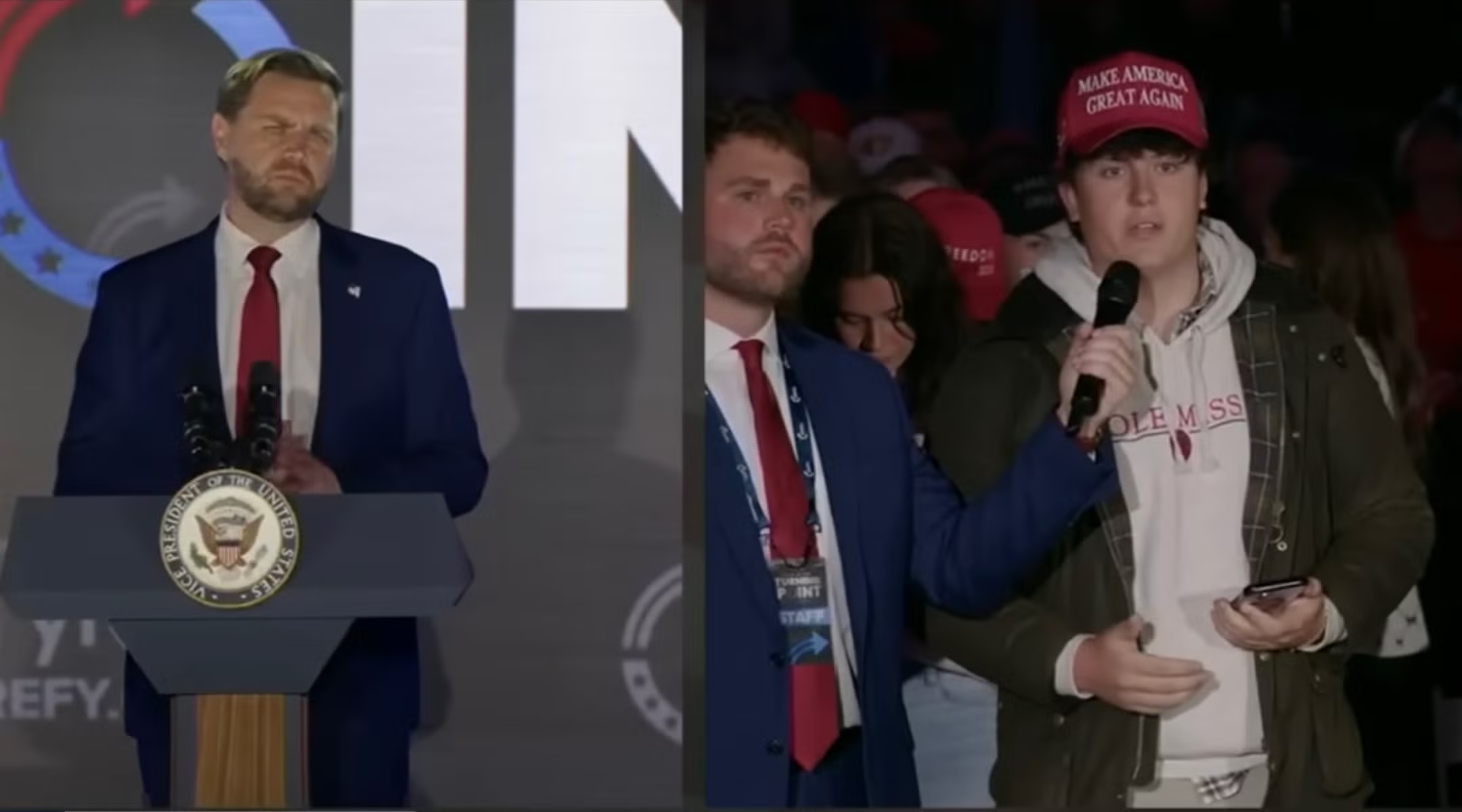
The oldest members of Generation Z are approaching 30. They entered childhood in the shadow of September 11, reached adolescence during the financial crisis, watched the Iraq War end without the victory their leaders had promised, and entered adulthood amid lockdowns, inflation, fentanyl, illegal immigration, institutional distrust, and a housing market increasingly closed to first time buyers. Their political education unfolded through searchable archives, leaked documents, campaign finance databases, congressional videos, podcasts, and social media rather than the three television networks that shaped earlier generations.
A new hard right party could emerge from that experience. Its founders would describe themselves as the generation handed the bill for decisions they never approved: the 1986 amnesty, the immigration expansion of 1990, the war in Iraq, the financial rescue of 2008, decades of rising public debt, and the failure to secure the border even when Republicans controlled Washington. Its central charge would be that the governing class protected its banks, foreign commitments, corporate labor supply, retirement programs, donors, and property values while the path to ownership narrowed for the people coming behind it.
The most likely beginning would take place inside the Republican Party. Young candidates would challenge incumbents in primaries, build local political organizations, enter law and public administration, and gradually replace the officials who treated border enforcement, industrial decline, family formation, and housing affordability as campaign themes rather than governing obligations. A formal third party could follow if the Republican structure proved impossible to capture. The first phase would look like an internal rebellion.
A Generation Inherits the Bill
The economic foundation of this revolt already exists. The National Association of Realtors reported in 2025 that first time buyers accounted for only 21 percent of home purchases, the lowest share in the history of its survey, while the median first time buyer had reached the age of 40. Before the Great Recession, first time buyers commonly represented about 40 percent of the market. Associated Press reporting on the housing crisis noted that the typical first time buyer remained between 30 and 32 years old from 1993 through 2018 before the age began rising sharply.
That delay reaches far beyond real estate. Homeownership helps determine when people leave their parents’ homes, marry, establish savings, raise children, and acquire a permanent stake in a community. Older owners benefited from years of rising property values and low mortgage rates, while later buyers encountered record prices, limited inventory, and higher borrowing costs. The Associated Press reported in July 2026 that the national median sales price had reached a record $440,600 in June. The country possesses immense land, capital, timber, construction knowledge, and industrial capacity, yet millions of young adults remain unable to purchase an ordinary home.
The loss of confidence follows the material decline. Pew Research Center found in 2024 that only 42 percent of adults under 50 believed the American Dream remained possible, compared with 61 percent of adults between 50 and 64 and 68 percent of those 65 and older. Pew also found that the share of Americans living in middle class households had fallen from 61 percent in 1971 to 51 percent in 2023. Those figures offer a political movement a powerful narrative: the people who benefited most from the old economic settlement are far more likely to believe that settlement still works.
Public debt adds another layer to the inheritance crisis. The Congressional Budget Office projected in February 2026 that the federal deficit would reach $1.9 trillion during the fiscal year and rise to $3.1 trillion by 2036. Debt held by the public would climb from 101 percent of the economy in 2026 to 120 percent in 2036, surpassing the previous record set after World War II. Rising interest costs would consume resources that future lawmakers might otherwise use for defense, infrastructure, tax relief, border enforcement, or family policy.
A Gen Z populist party would combine these conditions into one accusation. The governing generation enjoyed affordable homes, expanding asset values, comparatively inexpensive higher education, and the long peace dividend that followed the Cold War. Its leaders then expanded debt, immigration, financial risk, and military commitments while failing to preserve the same entry points for the next generation. The movement would call that record a transfer of wealth and security from the future to the present.
The Amnesty Bargain That Never Closed the Border
The 1986 Immigration Reform and Control Act would occupy a central place in the movement’s historical memory. President Ronald Reagan signed a law that offered legal status to millions of illegal immigrants while creating penalties for employers who knowingly hired unauthorized workers. The Library of Congress records that the law established civil and criminal sanctions against employers, while research summarized by the Migration Policy Institute found that about 2.7 million people ultimately received legal status.
The enforcement promise failed to produce a durable settlement. A detailed Migration Policy Institute review of the law concluded that employer sanctions never fulfilled their stated purpose and that the illegal immigrant population grew more than threefold after 1986. Fraudulent documents, subcontracting, weak verification, and limited enforcement allowed employers to continue drawing from illegal labor. The legalization remained permanent while the promised control over hiring steadily eroded.
Congress expanded the immigration system again four years later. The Immigration Act of 1990 raised the number of annual employment based immigrant visas from 54,000 to 140,000, created the Diversity Visa Program, and established the modern H-1B skilled worker category. A Migration Policy Institute review also notes that the law created Temporary Protected Status and substantially reorganized legal immigration.
A future nationalist party would connect these laws to a broader pattern. The federal government repeatedly expanded access to the American labor market while failing to build an enforcement system capable of preventing illegal hiring. Corporations gained access to a larger international labor pool, workers faced greater competition in particular industries, and citizens were assured that another reform package would eventually resolve the disorder.
The scale of the unresolved problem would sustain the argument. Pew Research Center estimated in 2025 that the illegal immigrant population reached a record 14 million in 2023. The same research estimated that 9.7 million illegal immigrants were working or seeking work, representing 5.6 percent of the national labor force. A movement organized around citizenship, wages, public order, and housing would treat those figures as evidence that Washington never completed the bargain it made in 1986.
Its immigration platform would likely include mandatory employment verification, severe penalties for employers who knowingly hire illegal labor, tighter asylum standards, large scale deportation of illegal immigrants, stronger control over visa programs used to replace or undercut American workers, and immigration levels tied to housing supply, public infrastructure, wage conditions, and the country’s capacity to absorb newcomers.
The party would place employers near the center of enforcement. Politicians have spent decades concentrating public anger on the people crossing the border while industries continued supplying the economic incentive. A serious enforcement system would target the entire chain: the illegal entrant, the employer, the labor broker, the document fraud network, and the public official who refuses to enforce existing law.
The War That Broke the Old Right
The Iraq War would define the movement’s break with the foreign policy establishment. The invasion began in 2003 with broad support from Republican leaders, major media organizations, defense officials, and prominent members of both parties. The central claims about Iraqi weapons programs collapsed, the occupation lasted for years, and the conflict helped produce a wider regional crisis whose consequences continued long after American forces withdrew.
Brown University’s Costs of War project estimated that the post September 11 wars had cost the United States about $8 trillion and directly killed between 897,000 and 929,000 people by 2021. The estimate includes military operations, homeland security spending, interest on borrowed money, and the enormous future cost of caring for veterans. Roughly $2.1 trillion of the total was attributed to the Iraq and Syria theater.
A younger right wing party would interpret that record as a diversion of national strength. The political class committed vast resources to transforming foreign societies while American manufacturing towns declined, border infrastructure remained incomplete, public schools weakened, and the federal debt accelerated. Military service would still command honor within the movement. The criticism would fall on the officials who sent service members into wars with shifting objectives, unclear definitions of victory, and little connection to the daily security of American families.
Its foreign policy would favor overwhelming strength against direct threats, a powerful Navy, secure borders, reliable nuclear deterrence, and a domestic industrial base capable of producing weapons without dependence on foreign supply chains. It would demand a specific American interest, a defined objective, congressional accountability, and a credible end before supporting another major war. The era of nation building would lose its authority over the right.
The Bailout and the Moral Fracture
The financial crisis of 2008 supplied the economic counterpart to Iraq. Congress created the Troubled Asset Relief Program as markets seized and major institutions approached collapse. The Treasury Department records that Congress originally authorized $700 billion, later reducing the authority to $475 billion. The Government Accountability Office found that Treasury ultimately disbursed $443.5 billion through TARP. Repayments and other income reduced the final lifetime cost to about $31 billion, a distinction that matters for an accurate accounting of the program.
The political meaning reached beyond the final balance sheet. Washington demonstrated that it could mobilize extraordinary sums and rewrite ordinary rules when the financial system faced destruction. Millions of homeowners experienced foreclosure, unemployment, depleted savings, and years of damaged credit. Younger Americans entered the labor market during a weak recovery while asset owners benefited from the long rise in stocks and housing that followed.
A future populist party would use the episode to attack a system in which losses become public during emergencies while gains remain private during expansions. It would support markets, ownership, enterprise, and investment while rejecting the automatic rescue of institutions whose executives and investors accepted enormous risks. Bank resolution rules, executive clawbacks, antitrust enforcement, transparent emergency lending, and protection against politically connected monopolies would become parts of its economic program.
The old Republican language of unrestricted markets would carry less authority with voters who watched the federal government intervene on behalf of finance. Their capitalism would be national and productive. It would favor builders, manufacturers, farmers, tradesmen, inventors, independent businesses, and workers who create tangible value. It would distrust systems that generate private fortunes through public guarantees, regulatory capture, cheap labor, financial engineering, or access to government contracts.
The Border Wall Failure
The border wall fight would become the movement’s clearest example of Republican weakness in power. Republicans controlled the presidency and both houses of Congress during 2017 and 2018. They lacked the 60 Senate votes generally required to overcome a filibuster on appropriations, yet voters had still been promised that unified control would produce decisive action.
In January 2018, Reuters reported that the Trump administration sought $25 billion for a border wall and another $5 billion for additional border security. Congress later approved about $1.6 billion for fencing and related infrastructure, far below the administration’s request. By the end of the year, the dispute produced the longest partial government shutdown in American history. Reuters reported in January 2019 that President Trump reopened the government after 35 days without receiving the $5.7 billion he had demanded.
The sums became symbols. Congress had authorized $700 billion for financial stabilization in 2008 and supported years of war spending measured in trillions, yet a central promise of the Republican president stalled over several billion dollars. Legislative rules and divided incentives explain part of the result. The political damage came from the gap between the rhetoric of emergency and the behavior of the governing party.
A new right wing faction would make border appropriations a test of loyalty. Candidates could no longer campaign on enforcement and then accept spending bills that left the central work undone. Border barriers, detention capacity, immigration courts, workplace enforcement, deportation operations, ports of entry, surveillance, and cooperation with state authorities would be funded as components of one system.
The movement would also study later evidence that priorities can change when political pressure becomes strong enough. Reuters reported in June 2026 that the House approved a roughly $70 billion package for Immigration and Customs Enforcement and Border Patrol after months of conflict over enforcement funding. The contrast with 2018 would reinforce a simple lesson: money appears when a governing coalition develops the will to supply it.
The Donor Republic
The party’s enemy within the right would be the donor system that separates campaign language from governing behavior. Republican politicians often promise lower immigration, restrained foreign policy, protection for domestic workers, and opposition to concentrated corporate power. Their campaigns remain dependent on wealthy individuals, political action committees, consultants, industries, and nonprofit networks whose interests may run in a different direction.
The scale of modern political money would make the argument easy to communicate. The Brennan Center for Justice found that dark money organizations, nonprofits, and shell companies spent more than $1.9 billion during the 2024 federal election cycle, nearly twice the previous record from 2020. Reuters reported that Elon Musk alone spent more than a quarter of a billion dollars supporting Donald Trump and Republican candidates.
A nationalist insurgency would distinguish between a donor who supports the movement’s program and a donor who purchases access to weaken it. The practical problem is dependency. Candidates who require a handful of enormous checks become vulnerable to industries seeking looser labor markets, favorable procurement, tax privileges, overseas commitments, regulatory protection, or government rescue.
The new party would probably emphasize small dollar fundraising, public disclosure, strict conflict rules, limits on stock trading by members of Congress, stronger registration requirements for foreign influence, and public records showing who finances major political organizations. It would also build businesses, legal groups, media outlets, and foundations aligned with its own worldview. Political independence requires institutions capable of paying their own bills.
What the New Party Would Stand For
Its core idea would be national preference. The government would place the security, wages, housing, families, constitutional rights, and future of American citizens at the center of policy. Markets, immigration, trade, military power, and federal administration would be judged by whether they strengthen the country and improve the position of its people.
The immigration program would combine border control with workplace enforcement. Mandatory employment verification would remove the economic reward for illegal entry. Employers who knowingly hire illegal labor would face serious financial and criminal penalties. Asylum would return to a narrower protection against genuine persecution. Deportation would operate at a scale sufficient to restore the credibility of the law. Legal immigration would continue where it clearly advances national interests, with visa rules designed to prevent corporations from using foreign labor to suppress wages or replace available Americans.
Its economic program would unite industrial policy with private ownership. The party would support domestic energy production, critical mineral development, shipbuilding, semiconductor manufacturing, defense production, agricultural security, and trade enforcement against countries that subsidize industries or steal technology. Apprenticeships, technical education, and skilled trades would receive the public respect and investment long reserved for four year universities.
Housing would become a national priority because family life depends on it. The government would accelerate permitting, encourage construction, expand infrastructure around growing communities, prevent monopolistic control of building materials, and limit the ability of enormous investment funds to dominate single family housing markets. A national policy would have to add supply rather than simply subsidize demand and push prices higher.
There are already signs that housing has become politically unavoidable. In June 2026, Congress passed a broad housing package by votes of 85 to 5 in the Senate and 358 to 32 in the House. The Associated Press reported that the legislation sought to reduce regulatory barriers, speed construction, support manufactured housing, encourage local reform, and restrict corporate purchases of single family homes. President Trump later chose to allow the bill to become law without his signature. The overwhelming congressional margins show that a political system famous for paralysis can still respond once a neglected issue becomes electorally dangerous.
Family policy would extend beyond tax credits. The movement would connect marriage and childbearing to wages, housing, health costs, neighborhood safety, and the ability of one parent to spend more time at home during a child’s earliest years. It would treat family formation as a national interest because a society unable to reproduce itself eventually loses economic dynamism, military strength, cultural continuity, and confidence in its future.
Its cultural program would emphasize religious liberty, free speech, public order, historical literacy, and equal application of the law. Schools would be judged by whether students can read, write, calculate, understand American institutions, and function as responsible adults. Public funding would follow public obligations. Universities and nonprofits receiving federal support would face greater scrutiny over political discrimination, administrative waste, and failure to deliver measurable educational value.
A Third Party Would Begin Inside the GOP
American election law makes an immediate third party breakthrough difficult. Single member congressional districts reward broad coalitions, presidential elections operate through the Electoral College, and voters often avoid minor parties out of fear that they will help elect the candidate they oppose most. A movement with serious ambitions would therefore begin by capturing an existing ballot line, voter base, fundraising network, and primary system.
The rise of the Republican Party provides the strongest historical precedent for a complete realignment. The United States Senate’s history of the Kansas Nebraska Act explains that the law destroyed the remnants of the Whig coalition and helped create the Republican Party. A separate Senate history describes how former Whigs and northern Democrats organized locally under the Republican name in 1854. The new party formed because the old parties could no longer contain the defining conflict of the era.
The Tea Party offers a more recent model of internal conquest. It developed outside the formal Republican leadership, recruited primary challengers, organized activists, and forced incumbents to respond to its demands. Pew Research Center found that 54 percent of Republican and Republican leaning voters identified with the movement at its high point before the 2010 election. The Tea Party later lost cohesion, but it proved that an organized faction could alter candidate selection, congressional behavior, and the party’s national agenda without establishing a separate ballot line.
A Gen Z nationalist movement would follow the same route with a broader program. It would target incumbents who campaign as populists and govern as conventional Republicans. Primary challenges would focus on specific votes involving immigration, foreign aid, trade, surveillance, spending, housing, technology, and corporate power. A few successful defeats would discipline many more officials who wanted to avoid becoming the next example.
A formal split would become likely only after a major confrontation over a presidential nomination, a war, an amnesty measure, or an economic crisis. The new organization might call itself the American Restoration Party, the National Republican Party, or the Home Front Party. Its name would matter less than the coalition underneath it: younger voters, working families, tradesmen, small business owners, veterans, religious conservatives, antiwar nationalists, border communities, independent media figures, and professionals who believe the old party uses their votes without advancing their interests.
The Rightward Opening Among Young Voters
Generation Z does not currently form a unified conservative bloc. Younger voters still contain large progressive, socialist, libertarian, religious, apolitical, and independent constituencies. The significant development is movement. Their party loyalties are less settled, their economic frustration is substantial, and their media habits make them harder for traditional institutions to control.
AP VoteCast found after the 2024 election that Donald Trump received 46 percent of the vote among Americans between 18 and 29, up from 36 percent in 2020. His gains were especially pronounced among young men and voters without college degrees. The result did not create a permanent Republican generation, though it demonstrated that younger voters can shift sharply when economic conditions, cultural appeals, and candidate strength align.
The broader electorate is also loosening its attachment to the two parties. Gallup reported in January 2026 that 45 percent of Americans identified as independents during 2025, the highest share in Gallup’s polling trend dating to 1988. Only 27 percent identified as Republicans and another 27 percent as Democrats.
Discontent with Congress creates another opening. Gallup found in April 2026 that 86 percent of Americans disapproved of Congress, tying the organization’s record. Republican approval of Congress had fallen sharply from the previous year, showing that control by one’s preferred party does not guarantee continued loyalty when governing results disappoint.
These conditions give a disciplined insurgency room to grow. It would not need an immediate national majority. It would need concentrated support in Republican primaries, several states, congressional districts where the existing party dominates, and professions that shape law and public policy. Political revolutions often begin with organized minorities operating inside institutions that the wider public has stopped trusting.
Technology Has Broken the Old Gatekeepers
The generation entering politics now has access to a record that previous voters could rarely inspect. Congressional votes, government reports, old speeches, court filings, donor disclosures, historical newspapers, agency budgets, and hours of archival video can be found within minutes. A politician can no longer depend on a local newspaper forgetting a broken promise or a television network declining to replay an old statement.
Young adults also receive information through channels that party officials do not fully control. Pew Research Center reported in 2025 that adults under 30 were especially likely to obtain news from Instagram and TikTok. Half said they placed at least some trust in information from social media, nearly matching the 51 percent who expressed trust in national news organizations.
That system allows a young candidate, writer, lawyer, or organizer to reach millions without obtaining permission from a television producer, newspaper editor, party committee, or large donor. It also rewards sensationalism, rumor, manipulation, and shallow certainty. The movement that masters distribution without developing judgment will remain a source of entertainment. The movement that combines distribution with law, history, economics, and administration can become a governing force.
The Literacy Crisis Inside the Information Age
The country’s access to knowledge has expanded while its ability to process difficult material has weakened. The 2024 National Assessment of Educational Progress found that the average reading score for high school seniors was three points lower than in 2019 and 10 points lower than in 1992. Scores declined across nearly every measured performance level.
That decline would shape the future party in two possible directions. It could exploit short attention spans with permanent outrage, simplified enemies, manipulated clips, and loyalty to online personalities. It could also build a serious educational culture capable of teaching constitutional law, American history, economics, rhetoric, statistics, theology, military strategy, and public administration.
A durable movement would need newspapers, magazines, publishing houses, reading groups, law societies, policy institutes, schools, and training programs. It would teach supporters how a bill becomes law, how appropriations work, how agencies write rules, how cities regulate land, how prosecutors exercise discretion, and how courts evaluate government power. Political literacy would become a form of self defense against both hostile institutions and incompetent allies.
Technology supplies access. Education determines whether access becomes knowledge. Experience determines whether knowledge becomes judgment. The generation that learns to combine all three will possess an advantage over leaders who still communicate through scripted appearances and consultant approved slogans.
From Online Revolt to Governing Class
The transfer of power would unfold through elections, professional advancement, appointments, and control over institutions. Young populists would enter law schools, military academies, police departments, construction firms, technology companies, seminaries, newsrooms, legislative staffs, and public agencies. Over time, some would become prosecutors, judges, state representatives, sheriffs, attorneys general, mayors, congressional committee counsels, and agency officials.
Law would become especially important. Lawyers write statutes, challenge regulations, negotiate settlements, advise governors, select judicial nominees, investigate corruption, and determine whether executive orders survive in court. A movement that produces popular content without producing capable attorneys will repeatedly watch its policies blocked, diluted, or reversed by people who understand institutions better.
State governments would serve as laboratories and training grounds. A nationalist governor working with an aligned legislature and attorney general could test employment verification, school reform, housing construction, foreign land ownership limits, election administration, public safety policy, and restrictions on state contracting. Successful programs would supply evidence for national legislation while successful officials would become candidates for Congress and the presidency.
Local government would matter for the same reason. Housing supply often depends on zoning boards, permitting offices, utility capacity, and local infrastructure. Public safety depends on prosecutors, judges, sheriffs, and police leadership. Education depends on school boards, state standards, teacher preparation, and curriculum decisions. The movement would gain lasting power when its supporters learn to govern those systems rather than discussing them from a distance.
Why the Republican Establishment Should Be Afraid
The old Republican establishment faces a coalition whose material interests increasingly conflict with the program it inherited from the late twentieth century. Younger voters need attainable homes, higher wages, secure borders, cheaper energy, reliable infrastructure, affordable family life, and relief from endless debt. Much of the traditional Republican donor class benefits from rising asset values, access to international labor, financial concentration, overseas investment, and a tax system designed around existing wealth.
That conflict can no longer be managed through speeches alone. A candidate who promises border enforcement can be measured against appropriations votes, deportation funding, employer penalties, and visa policy. A candidate who promises economic nationalism can be measured against trade agreements, procurement rules, industrial policy, and corporate subsidies. A candidate who promises peace can be measured against war authorizations, weapons packages, and deployments. Technology has made the record permanent and easy to distribute.
The Republican coalition has already demonstrated its capacity for rapid change. The party that nominated George W. Bush in 2000 defended free trade, military intervention, expanded legal immigration, entitlement reform, and close relations with major corporations. The party that returned Donald Trump to office in 2024 drew greater support from young voters, working class voters, and Americans without college degrees while adopting a more skeptical posture toward free trade, intervention, immigration, and corporate institutions. AP VoteCast documented the movement among young and noncollege voters that helped create this new coalition.
The next realignment could move further. It could replace tax focused conservatism with family economics, corporate immigration policy with national labor policy, interventionism with strategic restraint, and rhetorical opposition with institutional action. Republican officials can adapt while they still control the machinery. Those who refuse would face primary opponents drawn from the generation now entering professional and political life.
The danger comes from organized memory. The rising faction can place the 1986 amnesty beside the later growth of illegal immigration, the Iraq invasion beside its human and financial cost, the 2008 rescue beside the foreclosure crisis, the wall promises beside the 2019 surrender, and the language of fiscal responsibility beside a projected $1.9 trillion deficit. Each comparison converts a general feeling of betrayal into a documented political case.
The Country Still Has the Strength to Recover
A movement built entirely on decline would eventually exhaust itself. The United States retains the resources required for national renewal: abundant energy, productive farmland, navigable rivers, immense coastlines, deep capital markets, world class technology, major universities, military strength, religious communities, entrepreneurs, skilled workers, and a constitutional system that still allows peaceful political replacement.
The public has not abandoned the country’s central promise. Gallup reported in June 2026 that 78 percent of Americans still considered the American Dream worth pursuing. Fifty eight percent described the dream as unfinished, a view shared at nearly identical rates by Republicans, Democrats, and independents. The public’s frustration grows from the belief that the promise remains valuable while the institutions responsible for delivering it have failed.
The bipartisan housing legislation of 2026 also shows that pressure can still force action. Congress spent years avoiding a national housing shortage before passing a major package by overwhelming margins. The same possibility exists for border infrastructure, vocational education, domestic manufacturing, energy production, debt control, and family policy. The obstacles are political choices rather than an absence of national capacity.
A successful populist right would turn anger into construction. It would measure itself by homes built, illegal hiring reduced, factories opened, energy produced, streets secured, children educated, families formed, veterans cared for, and wars avoided. Governing competence would separate a genuine national movement from another cycle of internet outrage.
The Party After the Republican Party
The future hard right party would probably appear in stages. It would begin as a digital culture with writers, video creators, veterans, religious activists, lawyers, tradesmen, and young candidates sharing a broad diagnosis of national decline. It would develop into a primary faction capable of defeating selected incumbents. State organizations would follow, along with legal groups, policy institutions, newspapers, donor networks, and professional associations.
Once the faction controlled enough governors’ offices, state legislatures, congressional seats, and party committees, it would become the effective Republican Party regardless of the name printed on the ballot. A separate party would emerge only if the existing organization blocked the transfer through nomination rules, donor control, legal barriers, or a major break over war, immigration, or economic policy.
Its leaders would inherit a country burdened by debt, housing scarcity, weak literacy, illegal immigration, institutional distrust, and the remains of foreign commitments accumulated over decades. They would also inherit greater technological power, access to knowledge, productive capacity, and freedom of communication than any political generation before them.
The central struggle would concern whether that generation can move from exposure to administration. Finding a failed vote is easy. Writing a workable law requires discipline. Attacking an agency takes minutes. Rebuilding one requires years. Winning a primary can remove an incumbent. Governing successfully requires talented people who understand budgets, courts, construction, logistics, diplomacy, policing, and human nature.
The old Republican establishment still has time to choose its role. It can fund the border, defend American labor, restrain foreign commitments, expand housing, confront public debt, rebuild schools, and place family formation at the center of economic policy. It can also continue using populist language while protecting the arrangements that created the revolt.
The rising generation will eventually hold the offices, licenses, courtrooms, businesses, newsrooms, and institutions now controlled by older leaders. Its members will arrive with a detailed memory of the country they inherited and the decisions that shaped it. When that power transfer reaches its decisive stage, the Republican Party will either become the instrument of the new right or supply the ruins from which its replacement is built.