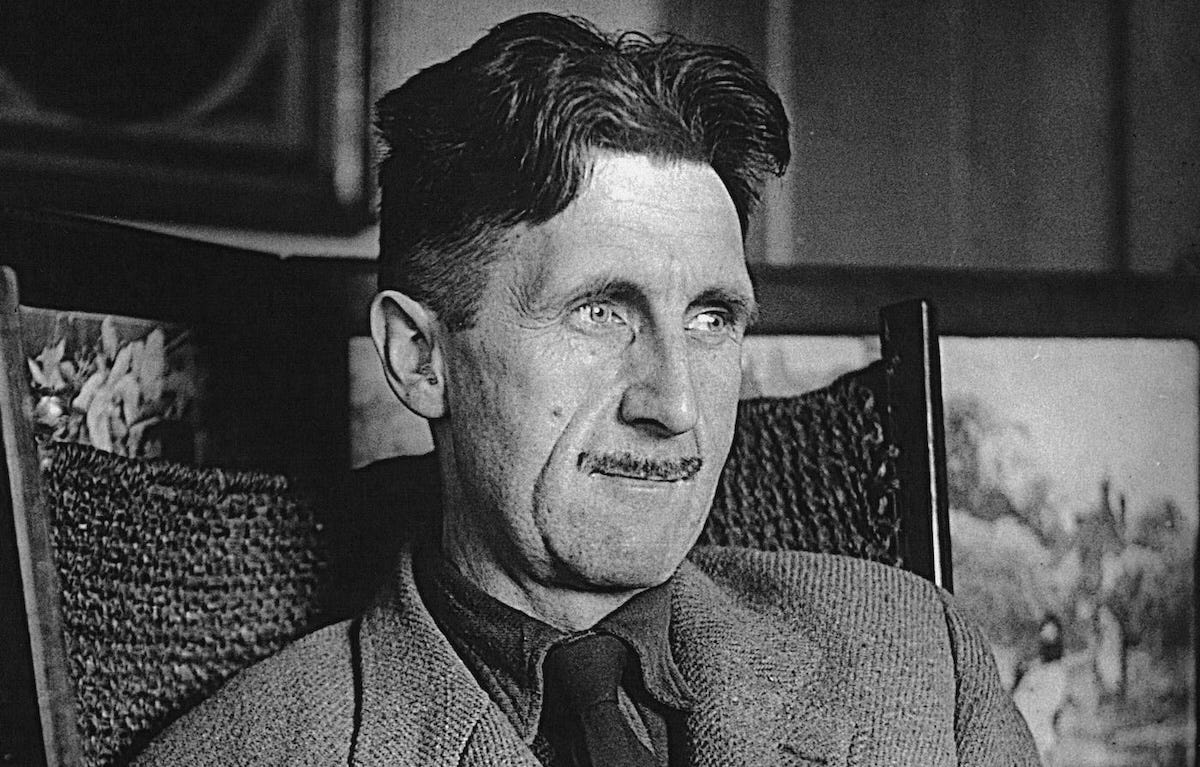
George Orwell’s reputation now rests less on what he actually believed than on what later generations wanted him to represent. Conservatives quote him as a defender of individual liberty, liberals invoke him against political deception, and socialists claim him as proof that the left can police its own abuses. Across all three camps, Orwell is treated as if he stood outside ideology and saw the future more clearly than everyone else.
That image collapses once his politics are examined closely. Orwell was a committed socialist whose most famous ideas grew out of political systems, literary works and historical events that already existed. He made sweeping predictions that failed, carried contradictions he never resolved and left behind books that are now used in ways he would not have recognized. The modern habit of treating 1984 as a universal explanation for censorship, surveillance and propaganda has done more to inflate Orwell’s reputation than to clarify the dangers he supposedly foresaw.
The phrase now appears across the political spectrum. Conservatives invoke Orwell against censorship, administrative power and cultural progressivism. Liberals invoke him against Donald Trump, populism and political misinformation. Socialists claim him as one of their own, while anti-socialists cite Animal Farm as though Orwell had written a defense of capitalism. Each faction takes the Orwell it needs and discards the rest.
What survives is not the historical George Orwell. It is a political mascot assembled from a few familiar slogans.
Orwell was not a neutral philosopher who rose above ideology and foresaw the entire modern world. In his own essay Why I Write, he described his serious work as consciously partisan, directed against totalitarianism and in favor of democratic socialism. He was an anti-Stalinist, but he remained a socialist. He was a perceptive critic of propaganda, but he was also capable of dramatic political misjudgments. He wrote a powerful dystopian novel, but he did not invent the political dangers it described.
Orwell deserves to be read as a writer. He does not deserve to be treated as a prophet.
The Socialist Behind the Conservative Quotations
The first step in dismantling the Orwell myth is to restore the political beliefs that his modern admirers routinely erase.
Orwell did not merely sympathize with disadvantaged workers or support a modest welfare state. During the Second World War, he advocated a fundamental socialist transformation of Britain. In The Lion and the Unicorn, published in 1941, Orwell called for the nationalization of land, mines, railways, banks and major industries. He proposed limiting the highest tax-free income in Britain to no more than ten times the lowest. He argued that Britain could not win the war without introducing socialism and could not establish socialism without winning the war.
Whatever distinctions may be drawn between democratic socialism, communism and social democracy, that program was far to the left of American conservatism. It placed the commanding institutions of national economic life under public ownership and treated the war as an opportunity for political revolution.
Orwell’s patriotism was real, but it was not conservative patriotism. He believed that England’s national traditions could be separated from its aristocratic and capitalist order, then redirected toward a distinctly English socialism. He did not want to preserve the economic system that existed around him. He wanted to replace it.
This is why the conservative habit of presenting Orwell as a Cold War defender of capitalism is so historically confused. His hostility toward the Soviet Union was not based on a belief that free-market capitalism represented the final political good. He believed Stalinism had corrupted socialism and discredited the socialist cause.
The distinction is not minor. It is the center of his politics.
Animal Farm Was Written to Rescue Socialism
Many Americans encounter Animal Farm as an anti-communist schoolbook and naturally assume that Orwell was attacking socialism itself. Orwell’s explanation was almost the opposite.
In his preface to the Ukrainian edition, Orwell wrote that his experiences during the Spanish Civil War had shown him how easily totalitarian propaganda could influence educated people living in democratic countries. The Soviet persecution of anti-Stalinist leftists convinced him that the mythology surrounding the Soviet Union was damaging the broader socialist movement.
He consequently described the destruction of the Soviet myth as essential to the revival of socialism.
That was the purpose behind Animal Farm. Orwell was not arguing that the animals should have accepted their original exploitation, abandoned the idea of equality and embraced the human owners as legitimate capitalists. He was portraying a revolution that had been hijacked by a new ruling class. The pigs did not prove that socialism was inherently false in Orwell’s mind. They represented the Soviet betrayal of what he considered authentic socialism.
The book can certainly be used to criticize revolutionary politics more broadly. Its account of concentrated power, manipulated history and the emergence of a privileged ruling class reaches beyond Orwell’s stated intentions. But that broader application should not be confused with Orwell’s own political conclusion.
He believed the revolution had been betrayed. He did not believe the desire for revolution had been disproven.
Nineteen Eighty-Four Was Not a Conservative Manifesto
The same misreading surrounds Nineteen Eighty-Four.
After the novel appeared in 1949, some readers interpreted it as an attack on Britain’s Labour government and on socialism generally. Orwell rejected that interpretation. In a statement issued shortly after publication, he said that the novel was not intended as an attack on socialism or the British Labour Party.
Orwell instead described it as an examination of the perversions to which a centralized economy could become vulnerable. He did not claim that the society depicted in the novel would necessarily arrive. He warned that something resembling it could emerge and that English-speaking countries possessed no natural immunity to totalitarianism.
This matters because Nineteen Eighty-Four is routinely presented as if Orwell had delivered a precise forecast of the twenty-first century. He did not. He constructed a satirical nightmare by intensifying tendencies already visible in Stalinist Russia, Nazi Germany, wartime Britain and the political movements of his own era.
The Party’s control over history reflected Soviet falsification and purge politics. The cult surrounding Big Brother drew from twentieth-century dictatorships. Permanent warfare reflected the emerging nuclear balance and the division of the world into rival blocs. The Ministry of Truth echoed the propaganda bureaucracies Orwell had observed during wartime. The fear of denunciation, ideological deviation and disappearing acquaintances emerged directly from the political terror he had witnessed among the left in Spain.
These were serious observations. They were not supernatural predictions.
Orwell Built on Dystopias That Already Existed
The mythology of Orwellian prophecy also depends upon treating Nineteen Eighty-Four as though it appeared without literary ancestors.
It did not.
The Open University’s examination of Orwell’s route to the novel notes the clear influence of Yevgeny Zamyatin’s We, written during the early 1920s. Zamyatin had already imagined an all-seeing state in which individuality was eliminated, citizens were reduced to numbers, private life was exposed to official inspection and rebellion was treated as a psychological disease.
Aldous Huxley had published Brave New World in 1932. H. G. Wells and E. M. Forster had also imagined technologically administered societies before Orwell completed his novel.
Orwell himself reviewed Zamyatin’s book in 1946. In that review, he described a society ruled by a leader called the Benefactor, supervised by political police called Guardians and organized around the principle that freedom and happiness were incompatible. The inhabitants lived in transparent homes that allowed the authorities to watch them. The protagonist joined a resistance, was captured, underwent a procedure that destroyed his imagination and then betrayed his comrades while watching the state torture them.
The resemblance to the later architecture of Nineteen Eighty-Four is obvious.
That does not make Orwell a plagiarist. Writers inherit traditions, adapt earlier ideas and transform common material. Orwell’s achievement was to combine those influences with the totalitarian history of his own age and express them through exceptionally durable political language.
But literary synthesis is not prophecy. Orwell did not discover surveillance, ideological conformity, historical falsification or political torture. He gave memorable English names to dangers that other writers and entire populations had already confronted.
His Actual Predictions Were Not Infallible
The easiest way to test the claim that Orwell was a prophet is to examine what happened when he made direct political predictions.
During the Second World War, Orwell became convinced that Britain’s existing social order could not survive. He argued that the country faced a stark choice between socialist revolution and defeat. The war and the revolution, he insisted, were inseparable.
Britain defeated Nazi Germany without undergoing the revolution Orwell had declared necessary. The postwar Labour government nationalized significant industries and expanded the welfare state, but the constitutional order survived, private property remained, the monarchy continued and Britain did not become the revolutionary socialist state Orwell had envisioned during the Blitz.
Orwell eventually recognized the error. In Second Thoughts on James Burnham, he criticized political writers who simply projected the most dramatic current trend into the future. Such predictions, he argued, often emerged from wishful thinking and a tendency to treat whatever was presently rising as permanent and irresistible.
The criticism applied uncomfortably well to Orwell’s own wartime judgment. He had interpreted military crisis, class resentment and economic mobilization as evidence that socialist revolution had become historically unavoidable.
He was wrong.
That does not erase his valid observations. It establishes that Orwell operated like other political writers. He interpreted events through his ideological commitments, sometimes saw genuine dangers clearly and sometimes mistook his preferred outcome for historical necessity.
A prophet is not supposed to require that qualification.
The Contradiction at the Center of Orwell’s Politics
Orwell’s most valuable insight was that concentrated power could corrupt movements that began with promises of equality. His most obvious political weakness was that he never fully resolved how his own economic program would avoid that danger.
He warned that centralized economies could be perverted into instruments of domination. Yet he also supported nationalizing the banks, land, transportation, mining and major industry. He wanted the state to possess enormous authority over production, ownership and income distribution while trusting democratic culture and English political traditions to prevent that authority from becoming tyrannical.
That was not an absurd position. Democratic governments have exercised substantial economic power without becoming totalitarian states. Public ownership does not automatically produce secret police, forced confessions or historical erasure.
Still, Orwell’s confidence rested heavily upon the character of the democratic society administering that power. The institutional question remained unresolved: what happens when the political movement controlling the centralized economy is no longer decent, tolerant or democratic?
Orwell could vividly describe the consequences of a ruling party controlling employment, information, housing, food and social advancement. His own socialist program nevertheless moved significant economic power toward public institutions.
The tension between those positions should be examined rather than hidden beneath admiration for his prose.
Orwellian Has Become a Substitute for Evidence
Even where Orwell was correct, his modern use often weakens political debate.
Calling a policy Orwellian does not establish that it is unconstitutional, coercive or dishonest. Comparing a government agency to the Ministry of Truth does not prove that its records are false. Describing a speech rule as Newspeak does not demonstrate that language is being centrally redesigned to make dissenting thought impossible.
The original concepts were specific.
Big Brother represented an omnipresent political ruler whose image reinforced the Party’s penetration of public and private life. Newspeak was an engineered language intended to shrink the range of expressible thought. Doublethink meant simultaneously accepting contradictory beliefs because political authority required both. The Ministry of Truth did not merely publish biased information. It continuously rewrote the documentary past so that the Party could never be shown to have been wrong.
Modern institutions can engage in censorship, manipulation and surveillance. Some comparisons to Orwell are legitimate. But most users jump directly to the literary label without establishing the factual mechanism.
Who is controlling the information? What specific record was changed? What speech is being prohibited? What legal authority is being exercised? What punishment follows dissent? Is the system centralized or competitive? Can citizens publicly challenge it? Can an opposition party reverse it? Can a court stop it?
Those questions produce political analysis. Saying “this is just like 1984” usually ends it.
The Fake Quotations Reveal the Cult
Perhaps nothing captures the modern Orwell industry better than the sayings falsely placed in his mouth.
The sentence “In a time of universal deceit, telling the truth is a revolutionary act” circulates constantly on political pages, campaign graphics and social-media accounts. So does the claim that the further a society drifts from truth, the more it will hate those who speak it.
The Orwell Society’s own collection states that Orwell said neither.
That has not stopped the quotations from spreading. They sound like what people imagine Orwell should have said, so they are repeatedly reproduced without verification. The invented prophet has become more useful than the real writer.
There is an irony here that even Orwell’s strongest admirers should recognize. A man celebrated for defending objective truth has become the fictional author of political slogans that he never wrote. The people sharing them are often doing exactly what they claim to oppose: repeating a convenient statement because it confirms their preferred narrative.
The Orwell cult no longer requires Orwell.
A Writer Worth Reading Is Not an Oracle Worth Worshipping
None of this requires pretending that Orwell was talentless or irrelevant.
He understood that political movements can corrupt language, excuse cruelty and rewrite their own histories. He recognized the willingness of educated intellectuals to defend repression when it served their faction. He saw that revolutions could replace one elite with another and that totalitarian systems sought control not merely over behavior, but over memory and judgment.
Those insights remain valuable.
But valuable observations do not make a man politically infallible. Orwell was an anti-Stalinist socialist who wrote from within the conflicts of the European left. His most famous novel borrowed from an established dystopian tradition and magnified political realities already visible in the first half of the twentieth century. His direct forecasts could be wrong, and his own program contained tensions that his admirers rarely confront.
The problem is not reading Orwell. The problem is invoking him as though his name resolves an argument.
A political culture capable of serious thought should be able to describe censorship without mentioning Newspeak, surveillance without mentioning Big Brother, propaganda without mentioning the Ministry of Truth and ideological hypocrisy without mentioning doublethink. History contains more than enough real regimes, laws, institutions, persecutions and political failures to make those arguments directly.
George Orwell was a gifted partisan writer. He was not a neutral authority, a conservative philosopher or a prophet sent to explain every future controversy.
The sooner political debate stops treating him like one, the better.