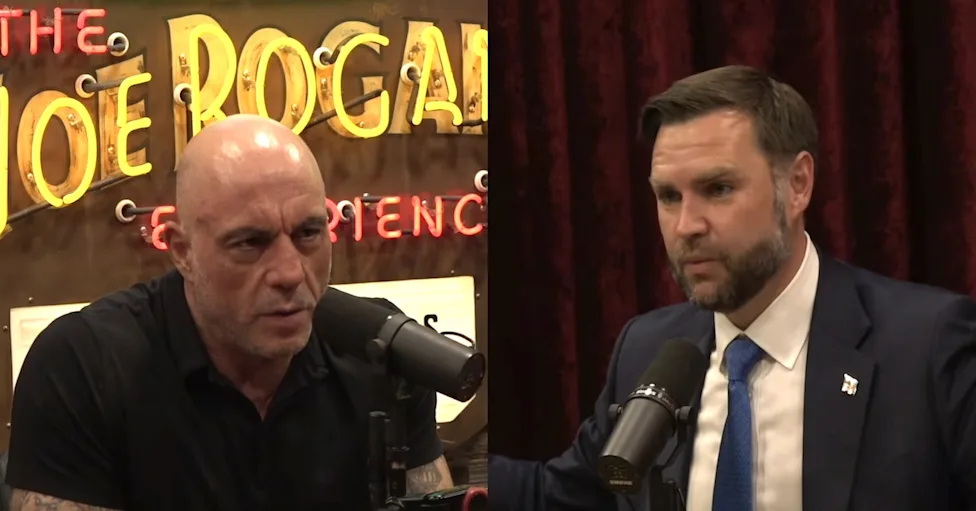
JD Vance went on Joe Rogan’s podcast this week and attempted something unusually difficult for a sitting vice president. He defended the president who ordered a war while constructing a public record suggesting that he had preferred another course.
During the sprawling Joe Rogan interview, Vance endorsed the goal of preventing Iran from obtaining a nuclear weapon, acknowledged that he had been less enthusiastic about military action than other officials and emphasized that his constitutional role required him to implement Donald Trump’s decisions once they were made. He also accused elements within the Israeli government of trying to manipulate American opinion against negotiations, while firmly rejecting the idea that Trump simply takes orders from Israel.
It was a carefully engineered political performance. Vance presented himself as loyal enough to remain Trump’s natural successor, independent enough to reassure conservatives exhausted by foreign wars and cautious enough to avoid declaring open conflict with Israel or its most powerful American supporters.
The interview also revealed the central problem that Vance is likely to carry into the next presidential election. He wants credit for trying to end the Iran war, distance from the decision to begin it and continued acceptance from the pro Israel institutions and donors that remain influential inside Republican politics.
Marco Rubio has chosen a simpler position. He has defended the war, defended Israel and placed himself squarely within the Republican tradition that views American power, Israeli military strength and pressure on Iran as mutually reinforcing. Their contrasting performances increasingly resemble the opening arguments of the 2028 Republican primary.
A Dissenter Who Cannot Publicly Dissent
Vance’s answer to the contradiction is presidential hierarchy.
He told Rogan that a vice president should offer honest advice privately, but that “once the president makes a decision,” his responsibility becomes making that decision successful. That formulation allows Vance to disclose that he had reservations without accusing Trump of making a mistake. It also permits him to tell antiwar conservatives that their views were represented inside the administration, even when their preferred policy did not prevail.
Vance has used this method repeatedly. He does not directly repudiate Trump’s war. He instead distinguishes between the president’s objective and the methods used to achieve it. Preventing an Iranian nuclear weapon was legitimate, in Vance’s telling. The open question was whether bombing, blockade, negotiation or some combination of the three offered the safest path.
That distinction will matter if the war remains unpopular. A future Vance campaign could argue that he supported Trump’s ultimate objective while consistently advocating a negotiated conclusion, limited military goals and resistance to another prolonged Middle Eastern occupation.
His opponents will have an equally straightforward response. Vance was vice president when the war began. He defended the administration after the attacks. He helped execute its policies and never resigned or publicly opposed them. Whatever disagreements occurred in private, he remains connected to the consequences.
The dilemma is intensified by Vance’s own political history. In 2016 he identified himself as a Never Trump conservative, described Trump as dangerous and privately wondered whether Trump might become an American version of Hitler. By 2024, he had become one of Trump’s most disciplined defenders. His transformation from Trump critic to running mate demonstrated both his capacity for ideological reinvention and his willingness to explain previous statements as the product of an earlier misunderstanding.
That history gives Vance a model for surviving inconvenient quotations. He can concede the words, dispute the interpretation and argue that events changed his judgment. It also gives his future rivals an established line of attack. The vice president who once reversed himself on Trump could be portrayed as a politician preparing another reversal on Israel, Iran or the war itself.
The Diplomacy Vance Wants to Own
Vance’s strongest claim to an independent foreign policy identity comes from diplomacy.
In April, he led the American delegation to Islamabad for what was expected to be the highest level meeting between representatives of the United States and Iran since the Iranian Revolution of 1979. The administration presented his presence as evidence that Washington was serious about finding an exit from the conflict. Expectations were low, the positions remained far apart and the talks ultimately failed to produce an immediate agreement. The Islamabad negotiations therefore cannot honestly be described as the moment Vance personally ended the war.
They did, however, establish him as the most visible political advocate for negotiation inside the administration. When the United States and Iran signed a preliminary memorandum in June, the White House deliberately credited both Trump and Vance with securing what it called an historic breakthrough. Its official account of the agreement described diplomacy as an extension of military strength and cast the arrangement as the fulfillment of Trump’s America First doctrine.
That presentation was politically convenient for both men. Trump received credit as the commander who forced Iran to negotiate. Vance received credibility as the official who helped convert force into an agreement.
The arrangement has not produced lasting peace. Fighting resumed, the Strait of Hormuz again became a source of crisis and Trump declared the ceasefire effectively over while continuing to leave open the possibility of further talks. A July Reuters and Ipsos survey found that 79 percent of Americans expected United States military involvement to continue for an extended period. Only 18 percent expected the war to end within weeks, while half believed the conflict had not been worth its costs.
Vance therefore faces the political burden of partial ownership. If negotiations eventually succeed, he can claim that persistence vindicated his strategy. If the agreement collapses completely, his opponents can portray Islamabad and the subsequent diplomacy as misplaced confidence in Tehran. If the war expands, antiwar voters may conclude that his influence inside the administration was either limited or ineffective.
Israel Becomes the Fault Line
Vance’s comments about Israel were more consequential than his defense of negotiation.
He said he had good relationships with Israeli officials and accepted that Israel, like every country, would attempt to shape American policy. “It doesn’t bother me that Israel tries to do this,” he said. His objection arose when foreign influence began affecting American political judgment. He later summarized his own position with a phrase intended to sound unremarkable rather than revolutionary: “I represent Americans first.”
The distinction was deliberate. Vance was not arguing that the United States should abandon Israel. He was claiming that an alliance does not grant Israel authority over American decisions involving war, energy prices, military deployments or negotiations with Iran.
He went further by saying that Israeli pressure helped move the United States toward the conflict and by accusing some members of the Israeli government of trying to undermine the subsequent negotiations. Israeli officials answered that the preliminary agreement failed to resolve their most important security concerns, including Iran’s ballistic missile capabilities, the future of its nuclear infrastructure and restrictions on Israeli operations against Hezbollah. Those objections were detailed in the Israeli response to Vance’s interview.
From Israel’s perspective, a temporary pause that leaves Iran capable of rebuilding its nuclear or missile programs may postpone a larger war rather than prevent one. Israeli officials also fear that an American desire for rapid disengagement could allow Hezbollah and other Iranian aligned forces to recover.
Vance’s answer is that military action without an attainable end state can produce permanent escalation. He has invoked Iraq, Libya and Syria as warnings about the consequences of destroying governments or military structures without a stable political settlement. His argument appeals to conservatives who believe the United States repeatedly mistakes tactical destruction for strategic victory.
The dispute concerns more than affection for Israel. It concerns which country determines the limits of American involvement and whether the security interests of Washington and Jerusalem remain identical when Israel seeks a longer military campaign than American voters appear willing to sustain.
The Pro Israel Coalition Is Powerful, but It Is Not Uniform
The backlash against Vance illustrated the danger.
Representative Randy Fine of Florida, one of the most aggressive pro Israel voices in Congress, called Vance’s earlier criticism of Israeli opponents of the agreement “absolutely inappropriate and frankly disgusting.” Fine argued that Vance spoke more respectfully about American enemies than an ally and questioned his fitness for the presidency. His public attack on the vice president offered a preview of how Vance’s words could be used during a Republican primary.
Fine’s position did not represent every pro Israel Republican. The Republican Jewish Coalition endorsed Trump’s attempt to negotiate, praised the degradation of Iran’s military capabilities and urged supporters to judge the memorandum by Iranian compliance. Its statement supporting the diplomatic effort remained deeply skeptical of Tehran but did not treat negotiation itself as a betrayal of Israel.
That difference matters. Republican Jewish voters, evangelical supporters of Israel, Israeli officials, defense oriented conservatives and large political donors do not form a single bloc with a single preferred policy. Some support negotiations after Iran’s military capacity has been weakened. Others believe any arrangement that leaves Iran’s governing system, missiles or nuclear knowledge intact creates unacceptable danger.
Vance is attempting to remain acceptable to the first group while resisting the second.
He has also been careful to separate criticism of Israeli policy from hostility toward Jewish Americans. That distinction is essential. The Israeli government, American Jewish voters and American pro Israel organizations are separate political actors. AIPAC describes itself as an American organization funded by Americans, not the Israeli government. It openly works to elect candidates who support the United States and Israel alliance and to defeat politicians it considers hostile to that relationship.
Vance’s suggestion that Israeli officials participated in a campaign to influence American opinion will therefore receive intense scrutiny. Any evidence must be evaluated specifically, without collapsing Israeli government activity, domestic lobbying and Jewish political participation into a single category. His language on Rogan was constructed to make that distinction, although some of his supporters and critics are unlikely to preserve it.
The Republican Electorate Is Moving Beneath Him
Vance’s political opportunity comes from a measurable generational shift.
Republican support for Israel remains strongest among older voters, white evangelical Christians and the party’s established foreign policy leadership. Younger Republicans are substantially less committed. A Pew Research Center survey published in April found that 57 percent of Republicans between 18 and 49 held an unfavorable view of Israel. Among Republicans aged 50 and older, large majorities continued to view Israel favorably.
That divide gives Vance a constituency Rubio cannot easily dominate. Younger conservatives who entered politics through hostility to the Iraq war, distrust of intelligence agencies, anger over foreign lobbying and skepticism of military commitments are more receptive to Vance’s argument that alliances must remain subordinate to a narrowly defined American interest.
The movement is broader than the Republican Party. A Quinnipiac University survey found that 48 percent of registered voters believed the United States was too supportive of Israel, the highest share since the university began asking the question in 2017. Only 7 percent believed Washington was not supportive enough. Republicans remained considerably more favorable toward existing support levels, but the national trend creates pressure on any politician seeking younger and independent voters.
Jewish public opinion is also more complicated than the conventional political categories suggest. Most Jewish Americans retain strong attachment to the Israeli people, but that attachment does not translate automatically into approval of the Israeli government. Pew found that 83 percent of Jewish adults viewed the Israeli people favorably, while only 47 percent held a favorable view of the Israeli government. Younger Jewish adults were less positive toward both than older Jewish adults.
Netanyahu is an especially weak political proxy for American Jewish opinion. An Associated Press and NORC survey found that roughly six in ten Jewish adults viewed him unfavorably, while about one third viewed him favorably.
Vance therefore does not face a simple choice between Israel critical young voters and uniformly pro Netanyahu Jewish voters. He faces overlapping groups that distinguish among Israel’s existence, its people, its government, Netanyahu’s leadership, American military aid and the question of whether the United States should fight Iran.
His political strategy is built around preserving those distinctions.
What the Donors Will Ask in 2028
Money remains the other side of the calculation.
AIPAC and its affiliated political network have become significant participants in federal elections. Miriam Adelson occupies a different but equally important position as one of the Republican Party’s most valuable individual donors and one of its most committed supporters of Israel. In 2024, she became the lead financier of a Trump supporting super PAC whose organizers aimed to exceed the roughly $100 million raised during the previous presidential cycle. Her role in financing the Trump campaign effort demonstrated the scale of resources available to candidates considered reliable on Israel.
There is no public evidence that AIPAC, Adelson or any other donor has issued Vance a future ultimatum. It would be speculative to claim that a particular meeting, demand or contribution has already been arranged.
The underlying political test is nevertheless predictable. Major pro Israel donors and organizations will examine whether Vance would sustain military aid, defend Israel during a regional war, prevent an Iranian nuclear weapon and resist efforts to isolate Israel diplomatically. They will also examine his allegations about Israeli influence, his criticism of Israeli operations and his willingness to negotiate with Tehran.
Vance has already prepared his response. He can point to his support for destroying Iranian nuclear facilities, his defense of Israel’s existence, his rejection of Iranian nuclear weapons and his insistence that Trump does not take orders from foreign governments. He can argue that his criticism was directed at particular officials and a campaign for indefinite war, rather than at Israel or Jewish Americans.
That defense may satisfy donors who want a dependable ally but accept limits on American military involvement. It may not satisfy those who believe public disagreement with Israel encourages its enemies or undermines deterrence.
Vance must also answer the opposite question from the younger conservatives he is courting. They will want to know whether his criticism has any practical meaning. A politician who warns about foreign influence but continues supporting military assistance, airstrikes and regional deployments may appear to be managing dissent rather than changing policy.
His position can survive only while both sides believe he might ultimately choose them.
The Administration Is Divided Over Means, Not Over Israel’s Existence
Descriptions of the administration as broadly hostile to Israel do not withstand scrutiny.
Rubio, Defense Secretary Pete Hegseth and senior White House adviser Stephen Miller have all supported a forceful campaign against Iran. Miller has described the objective in expansive military terms, arguing that Iran must be deprived of the ability to use missiles, energy disruption or nuclear development against the United States and its allies. His White House statements on the campaign place him much closer to the administration’s hawkish faction than to opponents of intervention.
Jared Kushner is not a cabinet secretary, and Miller is a senior White House official rather than the head of a cabinet department. Kushner has nevertheless returned as an influential diplomatic participant, working alongside Steve Witkoff in negotiations involving Iran and the broader Middle East. Rubio publicly confirmed Kushner’s participation in the diplomatic track.
The meaningful division concerns the use of American power. Vance and officials associated with the negotiating track place greater emphasis on defined objectives, negotiated exits and limits on Israeli operations that could widen the conflict. Rubio and the more traditional Republican hawks emphasize military leverage, Israeli freedom of action and the danger of accepting an agreement that Iran can exploit.
Both factions support preventing an Iranian nuclear weapon. Both describe Israel as an ally. Both remain formally subordinate to Trump. Their disagreement begins when the United States must decide how much war, economic disruption and strategic uncertainty it is willing to accept in pursuit of those goals.
Rubio Offers the Clearer Alternative
Rubio’s advantage is clarity.
He has defended the Iran campaign as necessary, described the threat as imminent and argued that American action benefited both the United States and the wider world. At a cabinet meeting, he called the war “a favor” to America and other countries. Vance spoke more cautiously before moving away from the subject. The contrast was sufficiently visible that the Associated Press treated it as an early dividing line in the 2028 contest.
Rubio has also defended Israel’s right to respond militarily and warned that Washington should not accept an Iran agreement merely for the sake of announcing peace. Vance has been more willing to argue that Israeli strikes can undermine American diplomacy. Their competing approaches reflect the Republican Party’s unresolved struggle between the foreign policy establishment that survived the Iraq era and the nationalist restraint that emerged from the reaction against it. Their diverging public positions have persisted even as both men insist that the administration remains united behind Trump.
Rubio’s July 16 address at the State Department should not be mischaracterized as a speech about Israel or Iran. It concerned the administration’s campaign against what it calls resurgent political terrorism from the far left. The official State Department description confirms that subject.
Its political meaning was still unmistakable. Rubio appeared behind a government lectern, surrounded by foreign officials, presenting himself as an authoritative secretary of state. Vance chose Rogan’s studio, where he could speak directly to younger men, anti establishment conservatives and voters skeptical of traditional media and foreign policy institutions.
Both appearances served their official purposes. Both also functioned as campaign auditions.
Rubio is offering certainty to defense conservatives, pro Israel voters and donors who want a president unlikely to hesitate in a regional confrontation. Vance is offering a revised Trumpism that retains military strength but promises greater suspicion of foreign pressure, narrower objectives and a quicker return to negotiation.
Neither man has announced a presidential campaign. Republican strategists and voters are already evaluating them as candidates. A Reuters examination of their emerging rivalry found that each was beginning to step beyond Trump’s shadow, even though neither had yet established broad national popularity.
The Heir and the Revisionist
Vance wants to inherit Trump without becoming trapped by every decision Trump makes.
That task may be impossible on Iran. The vice president participated in the administration that opened the war, implemented the military campaign, pursued the ceasefire, defended the preliminary agreement and returned to combat when the arrangement faltered. He cannot fully claim independence from any stage of that record.
His strategy is instead to create distinctions inside the shared record. Trump made the final decisions. Vance offered restraint. Trump ordered force. Vance sought an exit. Trump remains the leader of the movement. Vance is defining what the movement might become after Trump.
The approach is politically intelligent because the Republican coalition itself is divided. Older voters, major donors and traditional national security conservatives remain strongly supportive of Israel and suspicious of negotiations with Iran. Younger Republicans increasingly dislike prolonged wars, distrust Netanyahu and question whether American and Israeli interests always coincide.
Vance is trying to hold both groups by speaking in two registers. To Trump loyalists, he is the disciplined vice president who follows the commander in chief. To antiwar conservatives, he is the official who privately raised objections and publicly pursued diplomacy. To Israel’s supporters, he remains committed to preventing an Iranian nuclear weapon. To Israel’s critics, he is willing to say that Jerusalem sometimes pressures Washington toward policies that do not serve the United States.
The danger is that every audience eventually demands a final answer.
If the Iran war ends with a durable agreement, Vance can present himself as the strategist who converted military leverage into peace. If the conflict expands or produces years of instability, he will argue that his preference for diplomacy was correct, but he will remain part of the administration responsible for the outcome. If Israel becomes the defining fault line of the Republican primary, Rubio and other rivals will replay Vance’s accusations about Israeli influence. If opposition to foreign intervention dominates the party, they will replay his defenses of Trump’s war.
Vance is attempting to become both Trump’s heir and the correction to Trump’s second term. Iran is where those two ambitions collide, and where the Republican primary of 2028 has already begun.