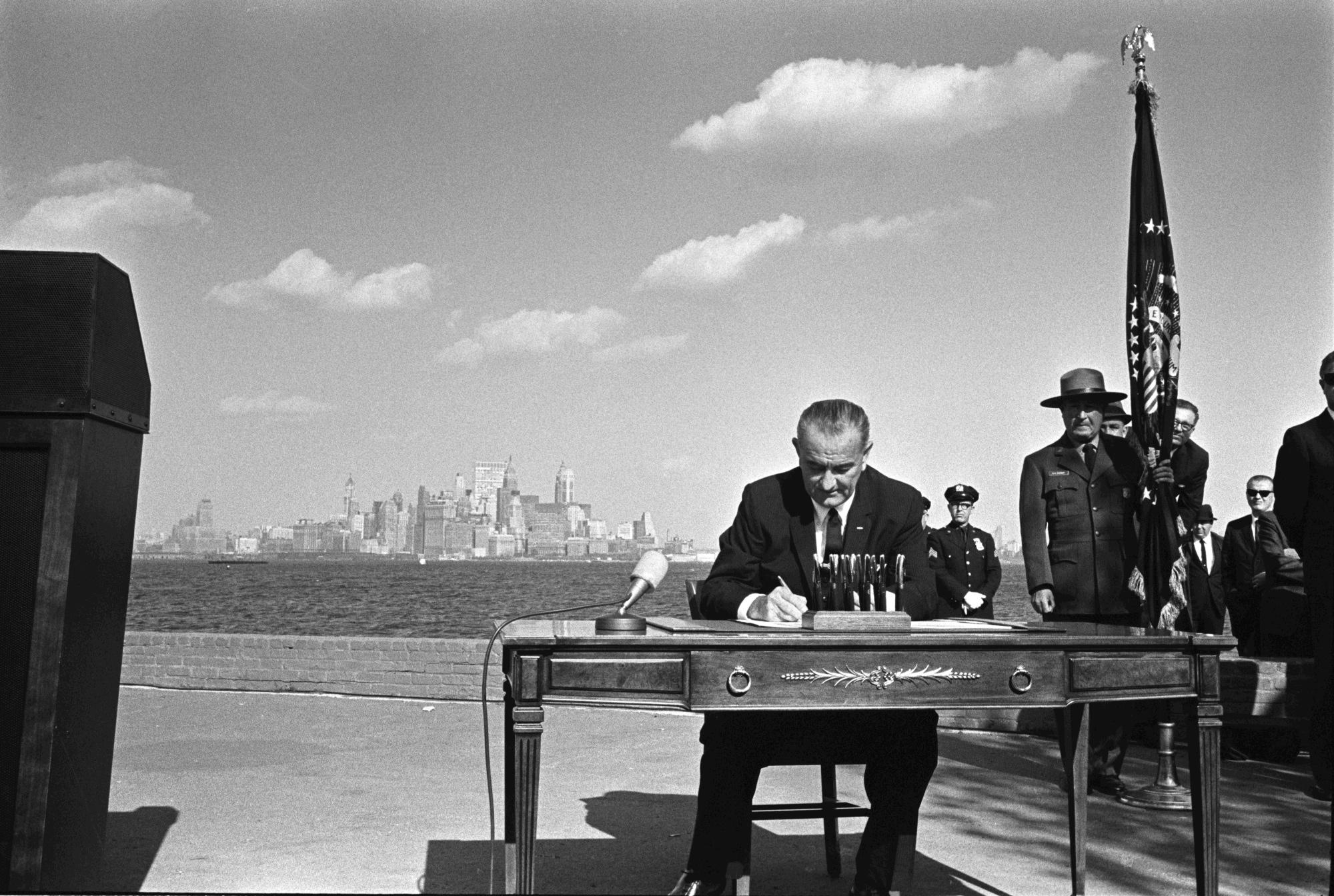
On Oct. 3, 1965, Lyndon B. Johnson stood beneath the Statue of Liberty and signed an immigration bill that he described as important but limited. It was, he said during the Liberty Island ceremony, “not a revolutionary bill.” It would correct an injustice, remove an offensive quota system and allow families to reunite, but it would not dramatically alter American life.
The judgment was understandable in the immediate context. The Immigration and Nationality Act of 1965, commonly known as the Hart-Celler Act after its congressional sponsors, did not authorize unlimited immigration. It established numerical ceilings, retained grounds for exclusion and continued to require immigrants to qualify through defined legal categories. Yet Johnson underestimated the cumulative power of the system he was signing into law. Once national origin ceased to determine eligibility, family sponsorship and migration networks gradually redirected immigration away from Europe and toward Latin America, Asia, the Caribbean and, later, Africa.
The country that enacted Hart-Celler was nearly 95 percent native born. The country entering the late 2020s has more than 50 million foreign born residents, with Mexico, India, China, the Philippines, Cuba and several Central American nations among the leading places of origin. The transformation emerged from more than one statute and cannot be attributed to 1965 alone. It was constructed through layers of law: the end of the Bracero labor program, new restrictions on Western Hemisphere migration, the Refugee Act of 1980, Ronald Reagan’s legalization and enforcement compromise in 1986, George H. W. Bush’s expansion of legal immigration in 1990, the punitive enforcement legislation of 1996 and the security bureaucracy created after Sept. 11.
The result is a system assembled across generations for different national purposes. Family unity, economic growth, humanitarian protection, border control, employer accountability and national security now coexist inside one immense legal structure, often in conflict with one another. As the United States moves into the 2030s with an aging population, declining fertility and an increasingly immigration dependent labor force, the consequences of those earlier decisions will become more difficult to avoid.
America Once Selected Immigrants by Ancestry
For much of the nation’s early history, federal immigration law was openly organized around racial and national distinctions. Chinese laborers were excluded beginning in the nineteenth century, while later restrictions barred or limited arrivals from much of Asia. The government’s authority evolved from regulating particular groups into determining how many immigrants could enter from each nation.
The decisive turn came in the 1920s. The Johnson-Reed Act of 1924 established a national origins system that allocated visas according to the ancestral composition of an earlier United States. The formula heavily favored northern and western European countries, sharply restricted southern and eastern Europeans and excluded most Asian immigration. Immigration policy became an instrument for preserving a preferred demographic balance rather than merely screening individual applicants.
Congress reorganized the system through the Immigration and Nationality Act of 1952, also called the McCarran-Walter Act. That law removed some explicit racial barriers to naturalization, consolidated immigration statutes and created occupational and family preferences. Yet it retained the national origins quotas that President Harry Truman considered discriminatory. The postwar structure therefore combined limited reform with the central architecture inherited from 1924.
The quotas had effects far beyond annual admission numbers. They communicated that an applicant’s birthplace carried a government assigned value. Britain, Germany and Ireland received relatively generous allocations. Italy, Greece, Poland and other parts of Europe received less favorable treatment. Asian nations received small symbolic quotas after decades of exclusion, while immigration from the Western Hemisphere initially operated under a separate framework.
By the 1960s, the system had become increasingly difficult to reconcile with American foreign policy and the civil rights movement. The United States was presenting itself as the leader of the free world while maintaining immigration rules that classified prospective residents through a hierarchy of national ancestry.
The America of 1965 Was Demographically Different
The United States that debated Hart-Celler contained about 180 million people and was less diverse by modern census measures. The 1960 census, using the categories and language of its time, classified 88.6 percent of the population as white. The country was also overwhelmingly native born. A separate census report found that approximately 95 percent of residents had been born in the United States, leaving the foreign born share near 5 percent.
Most immigrants still living in the country had come from Europe or Canada. Earlier restrictions, the Great Depression, two world wars and improving economic conditions in postwar Europe had reduced migration. The foreign born population continued falling after Hart-Celler’s enactment and reached a historic low of 4.7 percent in 1970, partly because the older European immigrant generation was dying faster than new immigrants were arriving.
Comparisons between 1960 and the present require care. The federal government did not comprehensively identify Hispanic origin as a separate ethnicity until the 1970 census, and the wording, processing and self identification options used for race have changed repeatedly. The Census Bureau’s historical methodology makes clear that modern Hispanic and non Hispanic categories cannot simply be projected backward onto the 1960 population.
Still, the broad contrast is unmistakable. America in 1965 was a predominantly native born society whose immigrant population was heavily European. Immigration levels were historically low, and the descendants of earlier European arrivals dominated nearly every major political institution. The legislators who rewrote the system were therefore attempting to remove discrimination from a country whose existing family relationships remained concentrated in Europe.
That fact influenced how supporters understood the bill. Many believed that retaining family preferences would preserve much of the existing immigration pattern because Americans of European descent would primarily sponsor European relatives. They did not fully anticipate how quickly migration networks could expand once the first arrivals from previously restricted countries became citizens and began sponsoring relatives of their own.
What Hart-Celler Actually Changed
The central achievement of the Hart-Celler Act was the abolition of national origins quotas. The statutory language declared that immigrant visas could not be distributed through preferences based on race, sex, nationality, birthplace or residence, except where the law itself established geographic limitations.
The act created a ceiling of 170,000 immigrants from the Eastern Hemisphere, with no more than 20,000 chargeable to any single country. It also established a separate ceiling of 120,000 for the Western Hemisphere beginning in 1968. Spouses, minor children and parents of adult United States citizens were defined as immediate relatives and exempted from the principal numerical ceiling.
For immigrants subject to the limits, Congress established a preference system. The largest shares were reserved for relatives of citizens and lawful permanent residents. Other categories covered professionals, people with exceptional ability, workers needed in occupations facing labor shortages and a limited class of refugees. Family connections received more visa space and higher placement than most employment qualifications.
The legislation therefore made three changes with enormous long term significance. It removed the ancestry based formula, made family sponsorship the principal engine of legal immigration and created an uncapped category for the closest relatives of American citizens. Every person admitted could later become a lawful permanent resident, naturalize and potentially sponsor additional family members.
Hart Celler did not eliminate immigration controls. It did not legalize unauthorized residents, abolish deportation, create an unrestricted right to immigrate or allow every American to sponsor any relative immediately. Applicants still faced annual ceilings, country limits, medical and security screening, financial requirements and waiting lists.
The law belonged to the same political era as the Voting Rights Act and the Civil Rights Act of 1964. Its moral logic was similar. A federal government dismantling racial discrimination at home could no longer comfortably defend an immigration system that treated ancestry as a proxy for worthiness.
That civil rights correction remains Hart-Celler’s strongest historical defense. The national origins system was deliberately unequal. Ending it did not require Congress to accept unlimited immigration, but it did require the government to judge applicants through rules other than an inherited hierarchy of ethnic preference.
A Demographic Transformation Few Sponsors Expected
The immediate effects of the 1965 law were modest. Immigration did not suddenly explode on the day Johnson signed the bill, and European migration did not disappear overnight. The transformation developed through accumulation.
Once immigrants from the Philippines, India, China, Korea and other previously restricted nations obtained permanent residence, they formed communities, entered professional institutions, became citizens and sponsored close relatives. The same process unfolded through migration from Mexico, the Caribbean and Central America. Family sponsorship reduced the uncertainty and cost of migration because new arrivals often entered communities where relatives could provide housing, employment information and social support.
The change in immigrant origins was profound. Census research found that about three quarters of the foreign born population was European in 1960. By 1980, the combined share born in Latin America and Asia had overtaken the European share. Subsequent migration strengthened that pattern.
Hart-Celler deserves substantial credit for opening legal channels to populations that the previous system had disadvantaged. Yet law operated alongside global conditions. Postwar European prosperity reduced incentives to leave Europe. Decolonization created new political and economic pressures across Asia and Africa. Air travel became cheaper. American universities and technology companies recruited abroad. Wars, revolutions, communist governments and economic crises displaced millions. Employers continued to demand workers at both the highest and lowest ends of the labor market.
The family system magnified these forces rather than creating all of them. Once a migration stream began, sponsorship helped it continue even when the original political or economic conditions changed. That cumulative process is often described as chain migration, though the legal term is family sponsored immigration. The process is neither automatic nor necessarily rapid. Many categories remain capped, and applicants from heavily represented countries can wait years or decades.
By 2024, the immigrant population had reached an estimated 50.2 million people, or 14.8 percent of the country. That equaled the record share reached in 1890, when the immigrant population was predominantly European. Mexico remained the largest single country of birth, followed by India and China, with the Philippines, Cuba, El Salvador, Vietnam, Guatemala, the Dominican Republic and Colombia also among the leading origins.
The contrast with 1960 is remarkable. Italians were then the largest immigrant group, while Germans and Canadians each represented roughly a tenth of the foreign born population. The modern immigrant population is larger, more globally distributed and less dominated by any single region.
The Mexican Migration Paradox
The relationship between Hart-Celler and Mexican immigration is more complicated than the common claim that the act simply opened the southern border. In one respect, the law made migration from Mexico more restricted.
From 1942 through 1964, the United States operated the Bracero program, which admitted Mexican laborers on temporary contracts, primarily for agricultural work. Nearly 4.5 million contracts were issued over the program’s history before it ended in 1964, one year before Hart Celler became law.
For decades, Western Hemisphere countries had not been subjected to the same national quotas imposed on Europe and Asia. Hart Celler established the first broad annual ceiling on immigration from the hemisphere, though it initially did not apply the 20,000 country limit there. Congress extended that country ceiling to Mexico and the rest of the Western Hemisphere in 1976, then combined the two hemispheric systems into a worldwide ceiling in 1978. A Ford administration analysis described the 1976 change as an effort to place both hemispheres under comparable rules.
The convergence of these policies mattered. Legal temporary labor opportunities had narrowed, permanent visas became numerically restricted and American employers continued hiring workers in agriculture, construction, hospitality and other industries. Existing family and labor relationships across the border did not vanish when Congress changed the legal categories available to them.
Sociologist Douglas Massey and other migration scholars have argued that these restrictions helped transform a historically circular labor flow into a larger unauthorized population. Their research on unintended consequences found that intensified border enforcement raised the cost and danger of returning to Mexico. Migrants who might once have worked temporarily and gone home became more likely to remain in the United States and bring their families.
That interpretation does not place all responsibility on federal law. Wage differences, Mexican population growth, employer demand, political instability, family formation and inconsistent enforcement were also important. It does reveal a recurring problem in immigration policy: restricting a legal channel does not necessarily eliminate the economic relationship that produced migration. It may instead change the legal status, duration and settlement pattern of the people who continue to move.
The Humanitarian System Grew Beside the Family System
Hart Celler contained a limited refugee preference, but Cold War refugee admissions often depended on special legislation and presidential action. Cubans fleeing Fidel Castro received particularly favorable treatment. The Cuban Adjustment Act of 1966 allowed many Cuban nationals already present in the United States to obtain permanent residence under rules unavailable to most other nationalities.
The fall of South Vietnam and conflicts in Cambodia and Laos brought hundreds of thousands of displaced people to the United States during the 1970s. Those movements exposed the limitations of handling each humanitarian crisis through temporary statutes and emergency programs.
Congress responded with the Refugee Act of 1980. The new law established a permanent and systematic procedure for admitting refugees, adopted a definition tied to persecution and created a more uniform federal resettlement structure. It also established the modern asylum process for people seeking protection after reaching the United States or its borders.
Refugees, asylum seekers, family sponsored immigrants, temporary workers and unauthorized migrants are frequently merged into one political category, but they enter the system through different legal authorities. Refugees are screened abroad and admitted under annual presidential ceilings. Asylum seekers request protection from within the country or at a port of entry. Family and employment immigrants generally require sponsorship and visa availability. Unauthorized immigrants may enter without inspection or remain after a lawful temporary admission expires.
The Refugee Act added a humanitarian obligation to a system already balancing family and labor considerations. As global displacement increased, asylum adjudication became intertwined with border management. Congress had created the legal right to seek protection without building an adjudication system consistently capable of deciding large numbers of cases quickly.
Reagan’s 1986 Compromise Legalized Millions but Settled Little
By the early 1980s, the unauthorized population had become too large to ignore. Employers could hire unauthorized workers without facing the comprehensive federal prohibition that exists today, while millions of residents had lived in the country for years without legal status.
The Immigration Reform and Control Act of 1986 represented the most ambitious attempt to address the problem through a broad compromise. In his signing statement, President Ronald Reagan identified three central elements: employer sanctions, stronger enforcement and legalization.
The law made it illegal for employers knowingly to hire unauthorized workers and required verification of identity and work eligibility. It also allowed certain people who had lived continuously in the country since before 1982 to apply for legal status, while providing a separate program for qualifying agricultural workers.
Approximately 2.7 million immigrants eventually obtained permanent residence through the legalization programs. For those families, IRCA was transformative. People who had worked in the shadows gained legal employment, greater mobility, protection from deportation and a path to citizenship.
The enforcement side proved less conclusive. Employers were required to inspect documents, but the government did not create a universal, fraud resistant employment verification system covering the entire labor market. Employers were forbidden from discriminating based on national origin or citizenship, yet were also expected to determine whether documents appeared genuine. The resulting system often punished blatant violations while leaving substantial room for document fraud, subcontracting and informal employment.
IRCA also addressed the population already present without creating a lasting formula for future workers whose labor was still demanded by American employers. Agricultural guest worker provisions expanded, but legal channels remained poorly aligned with the size and complexity of the low wage labor market. Unauthorized immigration consequently resumed.
Reagan’s compromise became a model that neither party has successfully repeated. Restriction advocates came to view the legalization as an amnesty whose promised enforcement was insufficient. Immigration advocates came to view enforcement measures as increasingly punitive and disconnected from legal admission opportunities. The collapse of trust surrounding the 1986 bargain has complicated every major reform effort since.
Bush Expanded the Front Door in 1990
Four years after Reagan signed IRCA, President George H. W. Bush approved the Immigration Act of 1990. Bush described the legislation as a combination of family reunification and skilled immigration intended to serve a more competitive economy. His signing statement explicitly connected the law to IRCA, arguing that the country had begun closing the unlawful back door and could now open the legal front door more widely.
The act significantly increased legal immigration and reorganized employment categories. It expanded visas for workers with advanced qualifications, professionals, investors and other employees sought by American businesses. It established the modern diversity visa program for applicants from countries with lower rates of immigration to the United States. It also created Temporary Protected Status, allowing the executive branch to protect certain nationals from removal when war, disaster or extraordinary conditions made return unsafe.
The 1990 statute established much of the numerical architecture that continues to govern permanent immigration. Family preferences, employment preferences and diversity admissions received defined annual allocations. Immediate relatives of citizens remained outside the principal caps, allowing total permanent admissions to exceed the statutory baseline when citizen sponsorship increased.
The law also expanded temporary employment pathways, including the specialty occupation system that became important to technology, medicine, universities and engineering. Employers gained greater access to international talent, but the number of permanent employment visas remained limited and dependents generally counted against the same ceilings as principal workers.
That design produces a recurring tension. The United States recruits temporary workers whom employers may want to retain permanently, then subjects them to numerical limits devised more than three decades earlier. Employees from populous countries can spend years in temporary status while waiting for permanent residence, tying their legal security to employers and administrative decisions.
Bush’s law did not replace Hart Celler. It reinforced its family centered foundation while adding a larger economic component. The modern legal immigration system is therefore best understood as a Hart Celler structure modified by the 1990 expansion.
The 1996 Law Made Immigration Enforcement More Severe
The political direction shifted sharply in the 1990s. Concern about illegal immigration, crime and public benefits produced a series of laws that narrowed relief and expanded the government’s ability to detain and remove noncitizens.
The Illegal Immigration Reform and Immigrant Responsibility Act of 1996 transformed immigration enforcement. The legislation expanded expedited removal, strengthened penalties for unlawful presence, broadened several grounds for deportation and limited forms of judicial and administrative relief.
Among its most consequential provisions were the three year and ten year bars. People who accumulated specified periods of unlawful presence and then departed could be barred from returning, even when they had close relatives or potential legal sponsorship in the United States. The rule created a trap for some immigrants who might otherwise have attempted to regularize their status through a consulate abroad.
The law also widened the use of detention and changed the terminology and procedure of deportation cases. Combined with other legislation enacted that year, it made criminal convictions more consequential for lawful permanent residents and applied some provisions to conduct that occurred before the law changed.
After the Sept. 11 attacks, immigration administration moved from the Justice Department into the new Department of Homeland Security. The former Immigration and Naturalization Service was dissolved in 2003, and its responsibilities were divided among agencies responsible for benefits, border operations and interior enforcement. The reorganization created the institutional framework now associated with Citizenship and Immigration Services, Customs and Border Protection and Immigration and Customs Enforcement.
That division reflected a security centered understanding of immigration. The agency deciding citizenship and visa petitions was separated from the agencies patrolling the border and making arrests. Yet the law remained unified underneath. A decision involving a visa overstay, asylum claim, criminal conviction or family petition could still pass through several agencies with distinct missions and incentives.
The Demographic Transformation Is the Central Result
The demographic consequences of post-1965 immigration policy are neither incidental nor unknowable. They can be measured across censuses, immigration records, schools, labor markets and successive generations of American births. The 2020 census found that the white alone non-Hispanic population had fallen to 57.8 percent of the country, down from 63.7 percent only a decade earlier. Hispanics of any race represented 18.7 percent, while the Black alone non-Hispanic population represented 12.1 percent. Other classifications, including Asian Americans, American Indians, Pacific Islanders and multiracial Americans, comprised the remainder.
Those figures should be handled precisely. Hispanic origin is an ethnicity rather than a race, many Hispanics identify as white, and federal classifications have changed repeatedly since the middle of the twentieth century. The census categories used in 1960 cannot be placed beside modern categories without qualification. The broad historical direction, however, is beyond dispute. The United States that adopted the Hart Celler Act was nearly 95 percent native born, and its foreign born population was still overwhelmingly European. The country created by the law’s cumulative operation is substantially more diverse in ancestry, national origin, language and cultural background.
The generational figures show why immigration policy continues reshaping the country long after an immigrant first arrives. White non-Hispanic Americans represented 60.8 percent of adults in 2020 but only 47.3 percent of Americans younger than 18. Hispanics represented 25.7 percent of the younger population, considerably above their share among adults. These differences reflect immigration, births to immigrants and later American born generations, along with intermarriage and changes in how people identify themselves.
It is therefore misleading to measure Hart Celler only by the number of foreign born residents living in the country during a particular year. Immigration is a multigenerational demographic policy. An immigrant admitted through a family or employment category may naturalize, sponsor relatives and raise children who are citizens from birth. Those children may later form families of their own. A law affecting several hundred thousand admissions in one year can consequently alter the population for decades without Congress casting another vote.
The labor market reflects the same accumulation. Foreign born workers made up 19.1 percent of the civilian labor forcein 2025, with especially large concentrations in service occupations, construction, maintenance, transportation and several professional fields. Their participation rate was higher than that of native born workers because the immigrant population is more heavily concentrated in working ages.
That statistic is often presented as proof that the country has become economically dependent on continued immigration. It can also be read as evidence of how deeply immigration policy has already changed the structure of the American workforce. Employers that have organized recruitment, wages and production around a continuously replenished foreign labor supply will naturally resist any policy that reduces it. Their dependence is partly the result of political decisions that allowed labor importation to substitute for higher wages, mechanization, domestic training and investment in workers already living here.
For restrictionists, the demographic question cannot be dismissed as an emotional response to ordinary social change. Governments routinely consider the long term effects of policy on population size, age, regional distribution, language and economic capacity. There is no reason national continuity should be excluded from that analysis. The descendants of the population that built the country possess a legitimate interest in whether federal policy rapidly and permanently transforms the society they will leave to their children.
That interest does not require hostility toward individual immigrants. It requires honesty about scale and consequence. A government may treat every applicant fairly while still deciding that admissions are too high, family categories are too expansive or the pace of change has exceeded the country’s capacity for assimilation. Immigration restriction is a judgment about national policy, not a judgment that every person admitted under that policy bears responsibility for writing it.
The 2030s Do Not Require More Immigration
The case for high immigration in the 2030s usually begins with the aging of the American population. Fertility remains below replacement level, the baby boom generation is entering retirement and the ratio of workers to retirees is declining. The Congressional Budget Office now projects that annual deaths will exceed annual births beginning in 2030, after which net immigration would account for all projected population growth.
That forecast is frequently presented as though it resolves the political question. It does not. The projection describes the population path produced by particular immigration assumptions. It does not prove that the United States must maintain continuous population growth, nor does it establish that replacing lower birthrates with immigration is the best response to aging.
A stable or moderately declining population is not inherently a national emergency. Japan, Italy, South Korea and several Eastern European countries face difficult aging problems, but population size is only one element of national strength. Productivity, automation, capital investment, family formation, public health and labor force participation also determine how a society supports its elderly. A country that produces more output per worker can remain prosperous without adding people indefinitely.
Immigration can temporarily improve the ratio between workers and retirees because many immigrants arrive during their prime working years. It cannot permanently abolish aging. Immigrants grow older, qualify for public benefits and form households that require housing, education, transportation and medical care. Preserving a worker to retiree ratio through immigration alone would require repeated population additions, because each imported working generation eventually becomes a retired generation.
The economic argument is similarly incomplete. The Congressional Budget Office estimated that the immigration surge beginning in 2021 would enlarge the economy and reduce projected federal deficits by increasing tax revenue. The same analysis found that the surge would also increase federal spending, place downward pressure on average real wages in the near term and raise mandatory expenditures as immigrants and their children became eligible for benefits. Total gross domestic product rises when the country contains more workers and consumers. That arithmetic does not demonstrate that the typical citizen becomes wealthier.
The distribution of the gains matters more than the national total. Employers benefit from an expanded labor pool. Landlords and property owners may benefit from stronger demand. Governments receive new taxes. Workers facing additional competition, young families seeking housing and municipalities financing schools and infrastructure may experience the costs more directly. An immigration policy can increase aggregate output while leaving wages, housing availability and public services under greater strain.
The argument that immigrants perform work Americans will not do should also be treated carefully. Employers generally mean that they cannot attract enough workers at the wages, conditions and locations they prefer. A labor shortage is a market signal. It can produce higher pay, safer conditions, training, relocation, automation and more efficient business practices. Importing workers suppresses some of that adjustment by allowing employers to preserve a lower cost model.
The United States should not answer a decline in native fertility by replacing missing births through permanent mass immigration. That approach accepts family decline as fixed while treating the demographic transformation produced by immigration as unavoidable. A government concerned about national survival would address why its own citizens delay marriage, have fewer children than they desire and struggle to afford housing, medical care and family life.
A restrictionist program for the 2030s would place American family formation ahead of population maximization. Tax relief for married families, lower housing costs, protection from wage competition, domestic industrial development and policies that make single income child rearing more attainable would address the causes of demographic weakness more directly. Immigration may increase the number of residents. It cannot substitute for the renewal of the existing nation.
A Visa System Designed for Continuous Expansion
The modern visa system is frequently described as restrictive because many applicants wait years for admission. In structural terms, however, it is designed to produce continuous immigration through several permanent channels that operate simultaneously.
For fiscal year 2026, the family sponsored preference limit remained 226,000, while the employment based limit was at least 140,000. Immediate relatives of American citizens, including spouses, minor children and parents of adult citizens, remained outside the principal numerical ceiling. The July visa bulletin also applied a 7 percent per country limit to capped family and employment preferences. Refugees, many asylum adjustments and several special categories operate through additional legal authorities.
The numerical ceiling therefore does not represent the actual total number of permanent immigrants who may be admitted in a year. Uncapped immediate relatives are added to the preference categories, while unused numbers can move between portions of the system under statutory formulas. Temporary workers, students and other nonimmigrants enter through separate programs, some of which provide later routes to permanent residence.
Family sponsorship gives the system its self perpetuating character. A person admitted today may eventually naturalize and acquire the ability to sponsor parents, adult children and siblings. Those relatives may later naturalize and sponsor relatives of their own. The process can take decades because of waiting lists, but delay does not change the mechanism. Each completed admission can create additional legal claims on future visa allocations.
The waiting lists are often cited as evidence that the answer must be more visas. They can just as logically demonstrate that Congress has promised immigration opportunities to categories too broad for any stable ceiling. Mexican applicants in the sibling category have waited on petitions dating to the early 2000s, while employment categories for India and China have faced severe backlogs. The State Department announced in May 2026 that India had already reached its annual EB-2 limit for the remainder of the fiscal year.
A restrictionist solution would not clear every backlog by increasing admissions until demand is satisfied. Demand to enter the United States is effectively limitless compared with any politically sustainable annual number. Congress should instead narrow eligibility so that the promises contained in immigration law correspond to the number of people the country has deliberately chosen to admit.
The immediate family of an American citizen presents the strongest claim. Spouses and minor children involve the nuclear household and should remain distinct from extended family categories. Adult siblings, married adult children and parents capable of creating further sponsorship chains involve a broader conception of reunification that Congress is not obligated to preserve. Ending those categories would not separate an existing nuclear family. It would end the assumption that citizenship carries a continuing right to relocate an extended family network into the United States.
The diversity visa should also be reconsidered. The program was explicitly designed through the Immigration Act of 1990 to increase admissions from countries with lower recent immigration rates. A congressional review described diversity, rather than a demonstrated labor need or immediate family relationship, as the program’s organizing purpose. A government pursuing lower immigration has little reason to maintain a lottery whose function is to create new migration streams where fewer previously existed.
Employment admissions should be narrower, temporary where appropriate and tied to a demonstrable national need that cannot reasonably be met through domestic recruitment or training. Employers should not control immigration policy merely by asserting a preference for a larger labor supply. The burden should rest on the employer to show that admission will serve the country rather than simply reduce labor costs.
The current system does not embody a coherent national strategy. It is a collection of inherited commitments that keep immigration flowing through family sponsorship, employment petitions, humanitarian programs, diversity selection and temporary status adjustments. Its complexity hides its direction. Whatever the annual fluctuations, the structure is designed to continue adding population unless Congress affirmatively stops it.
Hart Celler Must Be Judged by What It Did
The strongest defense of the Hart Celler Act is that it abolished the national origins quota system established in the 1920s. That system favored northern and western European countries, restricted southern and eastern Europe and excluded or severely limited immigration from much of Asia. Congress had ample reason to reconsider it in the civil rights era.
Ending national origins quotas did not require Congress to create the system that replaced them. Lawmakers could have adopted equal country limits at a lower overall level. They could have limited family sponsorship to spouses and minor children. They could have created temporary ceilings, automatic reviews or admissions tied to measurable economic conditions. Instead, Congress placed family reunification at the center of immigration law and exempted immediate relatives of citizens from the principal cap.
The distinction matters because defenders often treat repeal of the old quotas and creation of the new family system as one inseparable moral act. They were separate policy choices. A person can conclude that the 1924 formula had become indefensible while also concluding that the 1965 replacement produced immigration levels, migration chains and demographic effects that Congress should never have authorized.
The House historian acknowledges that policymakers vastly underestimated how many people would ultimately enter through family reunification. That point is central. The law was sold as a limited reform that would remove unequal treatment without transforming the country’s ethnic composition. Its principal sponsors denied that it would produce the kind of demographic revolution that followed.
Warnings existed at the time. During the 1965 hearings, critics urged Congress to examine the “hidden mathematics” of family sponsorship and explain the long term consequences to the public. A later House hearing preserved that testimony while describing family reunification as the cornerstone established by the act. The warnings proved more accurate than the reassurances.
The Office of the House Historian now openly describes Hart Celler as having produced a demographic revolution in the American population. That description is not propaganda from either side of the modern debate. It is the federal government’s own retrospective account of the law’s scale.
Hart Celler was not the only cause. The end of the Bracero program altered Mexican labor migration. Congress imposed numerical limits on the Western Hemisphere and later extended country ceilings. The Refugee Act of 1980 established the modern humanitarian system. Reagan’s 1986 law legalized millions while failing to establish durable control of unauthorized employment. Bush’s 1990 law increased legal immigration and created the diversity program. The 1996 reforms expanded detention and removal powers without reducing the legal admissions structure.
Those later laws intensified or redirected the transformation, but they operated within the architecture established in 1965. Hart Celler replaced a system intended to preserve the country’s inherited national composition with one that treated demographic outcomes as irrelevant so long as applicants qualified through formally neutral categories. That was a profound philosophical change in the purpose of immigration law.
A serious evaluation must judge the act through its consequences rather than the intentions of its sponsors. Lawmakers may have sought fairness between applicants, but their policy also transferred control of future immigration patterns from a national composition formula to family networks created by previous immigration. Once that structure began operating, admissions increasingly reflected which groups had recently arrived and acquired sponsors rather than a deliberate decision about the country’s long term character.
The betrayal was not that Congress permitted immigrants from previously restricted countries to apply under equal rules. It was that lawmakers assured the public the reform would not transform the nation, then left the resulting mechanism largely untouched after those assurances proved false. Successive Congresses watched the demographic consequences accumulate without asking the American people whether they wanted the transformation to continue.
A Moratorium and Enforcement Settlement for the 2030s
The United States does not have to choose between the existing system and a return to the national origins quotas of the 1920s. Congress can enact a race neutral immigration moratorium that reduces admissions across nationalities, protects the nuclear families of citizens, enforces existing law and gives the country time to absorb the population already present.
A serious moratorium would suspend most new permanent immigration for a defined period, potentially ten years, while preserving narrow exceptions for spouses and minor children of American citizens, individually approved humanitarian emergencies and people whose admission is essential to a specific national security interest. Adult sibling sponsorship, diversity visas, most extended family preferences and routine low wage labor admissions would be suspended or abolished.
The purpose would be consolidation rather than permanent isolation. The United States has absorbed historically high immigration over several decades while also confronting housing shortages, weakened public trust, strained infrastructure and declining confidence in the government’s ability to enforce its own laws. A pause would allow wages, schools, housing and assimilation institutions to adjust without adding another large annual cohort.
Legal reductions would have to be paired with interior enforcement. Border enforcement alone cannot control immigration while unauthorized workers can readily obtain employment after entering or overstaying a visa. Congress created employer sanctions in 1986, but the document based system remained vulnerable to fraud and inconsistent enforcement. A Government Accountability Office review found that employers were generally required to inspect documents visually without independently confirming them with the issuing agencies.
Mandatory employment verification should cover every new hire, with meaningful penalties for employers that knowingly employ unauthorized labor or evade the system through subcontractors. Enforcement must focus on the economic magnet as well as the physical border. Once unauthorized employment becomes difficult to obtain, incentives for illegal entry and visa overstays decline.
Large scale deportations would require administrative capacity and clear priorities. The government should begin with people who have final removal orders, serious criminal convictions, fraudulent claims, repeated immigration violations and recent unlawful entries. Immigration courts would require enough judges and support staff to complete cases promptly, while detention and transportation capacity would have to match the number of enforceable orders.
Due process should produce a real conclusion. A person with a valid legal claim should receive protection or lawful status. A person whose claim has been rejected after review should be removed. A system in which cases remain unresolved for years encourages additional claims, rewards delay and weakens confidence that immigration law carries consequences.
Congress should also reject another broad legalization before enforcement is complete. The central failure of the Reagan settlement was the sequence. Nearly three million people received legal status, but the employer verification and enforcement system proved too weak to prevent the unauthorized population from rebuilding. Legalization without prior control teaches future migrants, employers and politicians that unlawful residence may ultimately generate another political settlement.
Enforcement should extend to visa overstays, fraudulent sponsorship, misuse of temporary programs and employers that treat immigration status as a method of controlling labor. A restrictionist policy cannot focus only on the southern border while leaving other channels effectively untouched. The objective is a smaller and enforceable immigration system, not a symbolic campaign against one method of entry.
A moratorium would also create political space for a national family policy. Instead of replacing falling birthrates through immigration, Washington could reduce the economic burdens that discourage Americans from marrying and raising children. Housing construction, wage growth, family tax relief, vocational training and domestic industrial investment would strengthen the population already rooted in the country.
Assimilation would become more realistic under lower immigration. Schools and communities would have greater time to teach English, civic history and common national obligations without receiving new migration at a pace that continually reproduces linguistic and cultural separation. The objective would be incorporation into an existing nation rather than the indefinite transformation of that nation into a collection of parallel populations.
The country is not powerless before demographic projections. Census and CBO forecasts are based on assumptions about fertility, mortality and immigration, all of which can change. Policy created the present trajectory, and policy can alter it. Congress can reduce admissions, enforce departure, support family formation and decide that a larger population is not automatically preferable to a more cohesive and prosperous one.
The defining immigration question of the 2030s will be whether the United States continues operating a system whose demographic consequences were never honestly presented to the public. A moratorium, sustained removals and a smaller legal immigration program would amount to a national decision that continuity matters, citizenship carries priority and the American people retain the authority to determine the future character of their own country.